Customizing Spring Rate Curves With Volume Spacers Strategically
You tweak your spring rate curve with volume spacers by reducing air chamber volume, making the fork ramp up faster and resist bottoming without changing sag. Spacers increase pressure during compression via Boyle’s Law, letting you run lower air pressure for better small-bump comfort. Too many cause a harsh, wall-like end stroke. Fox uses snap-in, color-coded spacers; RockShox uses threaded spacers. Adjust counts based on your weight, terrain, and blow-through. There’s more to fine-tune.
We are supported by our audience. When you purchase through links on our site, we may earn an affiliate commission, at no extra cost for you. Learn more. Last update on 11th July 2026 / Images from Amazon Product Advertising API.
Notable Insights
- Volume spacers reduce air chamber volume, increasing pressure during compression to customize spring rate progression.
- Adding spacers steepens the spring curve, enhancing end-stroke support without altering sag settings.
- Strategically using spacers allows lower air pressure for better small-bump compliance while preventing bottom-out.
- Too many spacers create a harsh, “wall-like” feel; removal smooths progression and improves travel use.
- After adjusting spacers, recalibrate air pressure to maintain proper sag and suspension balance.
What Volume Spacers Do to Your Suspension
Every spacer you add reshapes how your suspension responds, and it all starts with reducing air volume in the positive chamber of your air spring. Volume spacers displace space inside your suspension’s air chamber, increasing air spring pressure as the fork or shock compresses. By adding or removing volume, you’re fine-tuning how quickly the spring rate ramps up, thanks to Boyle’s Law (P₁V₁ = P₂V₂). Smaller air volume means a more progressive spring, resisting bottoming out your suspension even on big hits. Testers riding aggressive trails found that with more spacers, their RockShox Vivid Air shock resisted blow-through despite 12 volume reducers maxing out the positive air chamber. You can run lower pressure for better small-bump grip without sacrificing end-stroke control. Remove spacers if you’re light or ride smoother trails and want easier access to full travel.
How Volume Spacers Change Suspension Progression
Why does your suspension feel plush at first but suddenly firm up as it compresses? That’s volume spacers at work. By reducing air volume in the positive chamber, they make air springs ramp up faster, steepening the spring rate curve-thanks to Boyle’s Law. Adding volume spacers increases suspension progression, boosting mid-stroke support and bottom-out resistance without affecting sag. You can run lower air pressure for better small-bump comfort while still protecting travel. Too many spacers, though, make the curve too aggressive, creating a “wall-like” end stroke that kills active feel. Removing volume spacers does the opposite, softening progression for more linear response. Fine-tune your suspension setup wisely-one spacer can transform ride quality. Systems like RockShox Vivid Air use up to 12 spacers, letting you dial in progression with precision across varied terrain.
Signs You Need More or Fewer Volume Spacers
How’s your suspension handling the choppy stuff-feeling too soft and slamming hard by the end of the stroke? If you’re bottoming out regularly despite correct sag and air pressure, adding volume spacers can help. They increase end-stroke resistance and control progression, keeping your suspension from blowing through its travel too soon. On the flip side, if your suspension compresses reluctantly and you can’t reach full travel, even with low pressure, removing volume spacers reduces progression for a more linear feel. Lighter riders (like those around 160 lbs) might struggle to use full travel no matter the number of volume spacers-sometimes, a lower spring rate is the real fix.
| Issue | Solution |
|---|---|
| Frequent bottoming out | Adding volume spacers |
| Hard to reach full travel | Removing volume spacers |
| Harsh spike in progression | Reduce number of volume spacers |
How to Install Volume Spacers on RockShox and Fox
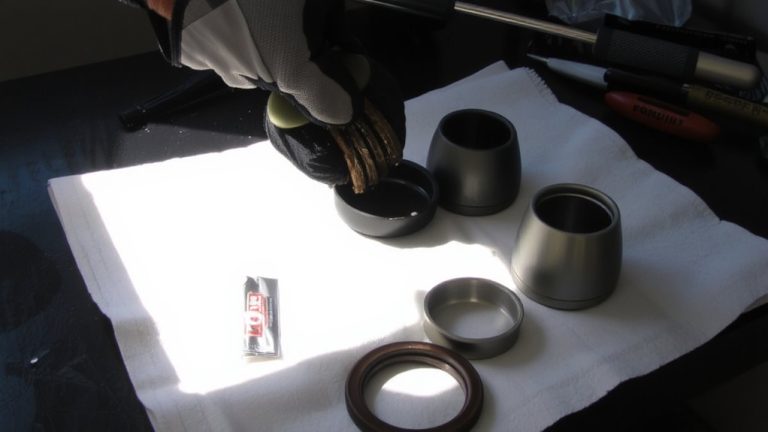
Though your fork might feel close to dialed, fine-tuning the spring curve with volume spacers can make a real difference in how it handles big hits and rough terrain. For RockShox forks, start by fully releasing air pressure, then remove the top cap with a cassette lockring tool. Thread in additional volume spacers into the positive air spring stack-these modular spacers stack precisely, letting you tweak spring progression in small increments. Reassemble and reinflate with your shock pump. On Fox forks, after releasing air pressure, use a 32mm chamferless socket to remove the air cap. Snap the color-coded volume spacers into the air spring’s designated slots-designs vary by model, with FIT4 and GRIP2 using specific single or two-piece spacers. Torque the cap back to 25 Nm. Both systems let you shape your suspension’s feel without altering sag, just recheck air pressure after changes.
How Volume Spacers Affect Sag and Pressure
You’ve seen how adding volume spacers to RockShox and Fox forks reshapes the spring curve, but now let’s clear up a common misconception-spacers don’t change your sag, at least not directly. Volume spacers, also called volume reducers, decrease the air chamber size, increasing pressure during compression and boosting progression without altering initial spring force. Your sag-say 28% of travel-stays set by air pressure, not spacer count. But here’s the key: you can lower air pressure (e.g., from 200 psi to 180 psi) and keep the same sag while gaining small-bump compliance. Less pressure with the same sag improves suspension performance and bike handling. Removing spacers does the opposite-softer initial feel if you drop pressure. Always recalibrate air pressure after changing spacers to maintain your target sag, ideally between 23% and 33%. A proper setup guarantees balanced compression, progression, and control.
On a final note
You’ve seen how volume spacers tweak spring rate curves, and now you can fine-tune your ride. Fewer spacers give a plush, linear feel in the first third, ideal for smooth trails; more spacers add progression, preventing bottom-outs on drops and rocks. Testers running 20–30% sag notice sharper response with one extra spacer on RockShox Lyrik or Fox 36. Dial it in, ride confidently, and match your setup to the terrain.