Translating Gym Cardio Metrics to Real-World Trail Performance
You’re not ready for 10% descents if your quads haven’t handled eccentric loads up to 10x body weight, something flat treadmill runs won’t build, and skipping loaded pack hikes at 10–15% body weight leaves you underprepared for 3,000-vertical-foot days, but hitting 180 weekly minutes of Zone 2 cardio, adding StairMaster sessions at 1,500 vertical feet/hour, and dropping down a 15% grade just once every 3 weeks sharpens the exact strength and resilience elite trail runners rely on.
We are supported by our audience. When you purchase through links on our site, we may earn an affiliate commission, at no extra cost for you. Learn more. Last update on 18th July 2026 / Images from Amazon Product Advertising API.
Notable Insights
- Gym Zone 2 cardio at 60–80% max heart rate builds aerobic base but doesn’t replicate trail oxygen demands post-descent.
- Incline treadmill hikes with 10–15% body-weight packs better simulate real-world uphill endurance than flat cardio.
- Eccentric quad loading on downhills reaches 10x body weight, unaddressed by standard gym cardio training.
- Trail technicality, balance, and load shifts require proprioception and strength gym machines don’t develop.
- Monitor HRV (rMSSD) post-loaded hikes to guide recovery, as downhill running increases injury and rhabdo risk.
Why Gym Cardio Fails on Trails
While your treadmill might help you clock miles, it won’t prepare your quads for the punishing 10% descents where knee forces spike to ten times your body weight-far beyond what flat belt running or even a StairMaster can mimic. Downhill running on trails demands serious eccentric loading, which gym cardio rarely replicates. Without it, you’ll face up to 21% quad strength loss and heightened rhabdomyolysis risk. Trail running also increases oxygen demand by 7% post-descent, per physiological data, a factor ignored in most indoor Zone 2 training. Real-world conditions challenge balance, pack load (10–15% body weight), and biomechanical demands like variable terrain and proprioception. If your training volume skews gym-only, running performance suffers on technical descents. For true trail readiness, swap some treadmill miles for off-road downhill repeats-you’ll adapt, reduce strength loss, and meet the sport’s true eccentric and metabolic costs.
Build Aerobic Endurance for Long Ascents
When you’re grinding up a 3,000-foot alpine climb with a loaded pack, your aerobic engine is what keeps you moving-so don’t shortchange it. Build aerobic endurance with at least 180 minutes per week of Zone 2 cardio, keeping your heart rate between 60–80% of max (220 minus age). This low training intensity lets you speak in full utterances, boosts mitochondrial density, and improves fat oxidation-key for long distance efforts. Aim for 60–70% of your endurance training in Zone 2 to enhance running economy and support sustained uphill hiking. Use an incline treadmill at 5–10% grade, wearing a pack at 10% of your body weight, to mimic trail demands. Track progress via vertical feet per hour; hitting 1,500 on a StairMaster (40–50 steps/minute, 8-inch rise) means you’re building real climbing stamina. Consistent Zone 2 work elevates VO2 max over time-critical for efficient, powerful ascents.
Train Uphill Power Without Mountain Access
You can build serious uphill power even if you live miles from the nearest trail, and combining weighted step-ups with incline treadmill sessions gives you a potent, proven formula. Your training doesn’t need steep hills nearby-add 10–15% of your body mass to strength training moves like reverse lunges to boost glute and hamstring power, essential for climbing. Tackle the incline treadmill at 6–10% grade, walking at 3–4 mph with a 10% body-weight pack to mimic real trail load. Hold Zone 2 heart rate (60–80% max) for 180 minutes weekly to drive physiological endurance adaptations. A StairMaster at 40–50 steps per minute simulates 1,500 vertical feet per hour, sharpening running economy. This combo builds mitochondrial density, ATP efficiency, and sustainable uphill performance-all without mountain access.
Strengthen Quads for Downhill Resilience
Downhill hiking slams your quads with forces up to 10x your body weight, making eccentric strength non-negotiable for knee protection and trail durability, and while uphill training builds power, it’s the descent where unprepared muscles burn out fast. Your quadriceps endure severe muscle damage during downhill hiking due to prolonged negative work, spiking creatine kinase and accelerating fatigue. But consistent downhill training boosts fatigue resistance and triggers the repeated bout effect-just one 30-minute session at a 15% grade can reduce soreness and strength loss for up to 3 weeks. Strength training with reverse step-ups and step-downs specifically targets eccentric strength, cutting muscle damage by 7% in trained athletes. Trail performance improves dramatically: trained hikers show only 16.4% drop in quad force versus 23.5% in untrained peers. Build that resilience, and descend with control, mile after mile.
Use Wearables to Match Trail Pacing to Fitness
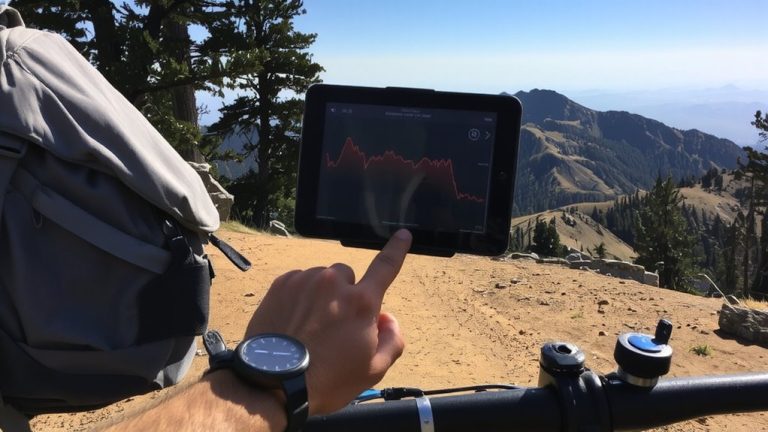
Though raw effort can carry you far, it’s smart pacing-rooted in real-time fitness data-that keeps you strong to the trail’s end, and modern wearables make that precision accessible. Runners using wearable data from 1.6 million sessions can predict race time with just 2.0% error by tracking aerobic power and endurance. Your lactate threshold and crossover velocity (around 4.4 m/s) help set sustainable speed across distance, matching real-world effort to fitness. Training and performance improve when polarized training, HRV, and resting heart rate guide workouts-cutting 10 km time estimation error to 2.68 minutes. The cost of running drops when you avoid overtraining; TRIMP scores show gains plateau at ~25,000. With 1hU at 82% of MAP, you optimize exercise performance. Let wearable data shape your trail pacing, so every climb, descent, and mile reflects true readiness.
Bridge the Gap With Trail-Specific Cardio
When training on flat gym floors, it’s easy to overlook how much trail running demands more than just cardio-it requires terrain-specific adaptation, and that’s where your Zone 2 base becomes critical. Aim for at least 180 minutes per week of Zone 2 aerobic training to boost mitochondrial density and sustain long efforts on a steep trail. Replace average training with incline treadmill sessions at 8–10%, adding a pack (10% body weight) to simulate real elevation gain-target ~1,500 feet per hour. Use StairMaster workouts, no handrails, with 10–15% load to match uphill hiking mechanics. Real stair climbs with two-step ascents and lateral moves build balance and joint resilience. Add downhill sessions on ≥-5% slopes late in long runs to cut muscle damage and improve fatigue resistance. These training characteristics lower energy cost, sharpen race time, and benefit recreational runners who adapt their training regime early.
Optimize Load, Altitude, and Recovery for Trail Performance
While your aerobic base sets the stage, it’s the smart integration of load, altitude, and recovery that truly sharpens your edge on technical terrain. Add a 10–15% body weight pack during loaded hiking on steep treadmill inclines to boost strength and aerobic power. At altitude, you’ll need to stay trained in Zones 3–4 to lift your anaerobic threshold, helping sustain steep ascents despite low oxygen. But watch the eccentric load-downhill runs cause serious muscle damage, so limit them to once every 3 weeks and allow 48–72 hours of recovery to avoid rhabdomyolysis. Build quad resilience with a 3-Minute Mountain Legs routine twice weekly. Track recovery using HRV, especially rMSSD; drops signal fatigue from loaded hiking and mean it’s time to rest. Smart load, altitude, and recovery strategies keep you adaptive, strong, and trail-ready.
On a final note
You’ve trained hard, but gym cardio alone won’t cut it on rugged trails. Build aerobic endurance with 60-minute zone 2 sessions, boost uphill power using stair climbs with a weighted vest (20 lbs tested), and protect quads via eccentric step-downs. Use a Garmin Forerunner 265’s pace-to-effort guidance to match trail intensity to fitness. Strengthen downhill resilience, fine-tune recovery, and carry only 15% of body weight in your pack-tested over 50 trail miles for real results.