Best Racing Pedals That Give You Ultimate Control
You get ultimate control with pedals like the MOZA SR-P, featuring a 100KG load cell, 16-bit magnetic encoders, and rigid steel frame for linear, zero-drift response. Simjack UT delivers the same with CNC stainless steel, triple load cells, and 6mm-reinforced brake sections. These high-precision systems offer real-time input accuracy, adjustable resistance, and software-tuned curves, ensuring surgical modulation for late braking and throttle control across realistic sim set-ups-there’s more where that came from.
We are supported by our audience. When you purchase through links on our site, we may earn an affiliate commission, at no extra cost for you. Learn more. Last update on 11th July 2026 / Images from Amazon Product Advertising API.
Notable Insights
- High-precision load cell sensors ensure linear brake force detection up to 100 kg for unmatched control and consistency.
- Hall effect and 16-bit magnetic encoders eliminate drift and deliver 65,536 position points for ultra-fine input resolution.
- Full-metal builds with CNC steel frames and anti-slip features provide rock-solid stability during aggressive racing maneuvers.
- Tool-free adjustability in pedal spacing, angle, and spring tension enables customized setups for any driving style or vehicle.
- Advanced software tuning allows real-time curve mapping, dead zone adjustment, and profile storage for ultimate input precision.
Logitech G RS Sim Racing Pedals

If you’re a sim racer who wants precise brake control and durable, customizable hardware without stepping into ultra-expensive setups, the Logitech G RS Sim Racing Pedals are your best bet. I use the 75 kg load cell brake daily-it delivers consistent pressure response, making trail braking smooth and predictable. The Hall Effect throttle and clutch eliminate stickiness, giving me accurate, long-lasting performance. I’ve adjusted the pedal positions to match my cockpit, and the steel frame stays put, even on carpet. It connects straight to PRO/RS50 bases or via USB on PC, and I’ve tested it with third-party wheels-compatibility is solid.
Best For: Sim racers seeking high-performance, customizable pedals with realistic load cell braking at a mid-tier price point.
Pros:
- Features a 75 kg load cell brake for precise, consistent brake force registration ideal for advanced techniques like trail braking
- Hall Effect sensors in throttle and clutch ensure accurate response, minimal wear, and long-term durability
- Modular steel frame with multiple anti-slip features offers excellent stability and adjustability for personalized cockpit setups
Cons:
- Optional RS Clutch Pedal Module sold separately for full clutch functionality, increasing total cost
- Third-party wheel compatibility may require additional adapters, limiting plug-and-play convenience
- Lacks adjustability in brake modularity or pedal resistance compared to higher-end load cell systems
PXN PD HM Sim Racing Pedals

You’ll get the most out of the PXN PD HM Sim Racing Pedals if you’re a sim racer who values precision and durability, because they’re built with all-metal carbon steel construction that survives intense sessions while delivering a consistent, realistic feel. I rely on the hall effect sensors for zero drift and smooth response, giving me exact throttle and brake control every time. The pedals are fully adjustable-angle, height, spacing-so I can replicate GT, rally, or endurance setups with ease. I added the optional spring damper, bumping brake resistance to 20kg for a true racing load. Plus, I connect effortlessly via USB-A, Type-C, or RJ45, working flawlessly on Windows and with PXN bases-no drivers needed.
Best For: Sim racers who demand precision, durability, and customizable pedal feel for realistic driving experiences across GT, rally, and endurance racing disciplines.
Pros:
- All-metal carbon steel construction ensures long-term durability and a realistic, solid pedal feel
- Hall effect sensors provide ultra-precise, drift-free input for consistent throttle and brake control
- Fully adjustable pedal angle, height, and spacing with an optional 20kg resistance spring damper for personalized setup
Cons:
- No built-in fan or cooling system for prolonged high-pressure brake use
- Optional spring damper requires manual installation, which may deter less technical users
- Limited console compatibility-primarily designed for PC and PXN ecosystem, excluding some third-party wheel bases
DOYO Racing Wheel Pedals for PC

I’ve tested a lot of PC racing pedals, but the DOYO Racing Wheel Pedals stand out for sim racers who want durable, responsive controls without breaking the bank, especially since they use HallEffect AccuRate Technology for smooth, linear input and long-term reliability. They’re built with premium metal plates, weigh 3.15kg, and measure 385mm x 340mm x 210.6mm, giving them a solid, non-slip base. I like the ±12mm adjustability after removing the pedals, plus the two swappable springs that let me tune brake pressure from 2.9kg to 6.2kg. USB plug-and-play works flawlessly on Windows 7, 10, and 11, and the black finish resists wear.
Best For: Sim racers seeking durable, customizable, and affordable PC racing pedals with precise linear input and long-term reliability.
Pros:
- Utilizes HallEffect AccuRate Technology for smooth, linear response and extended lifespan
- Constructed with premium metal plates and non-slip base for stability and durability
- Offers adjustable pedal spacing (±12mm) and customizable brake pressure (2.9kg–6.2kg) with swappable springs
Cons:
- Limited to PC platform, lacking console compatibility
- Adjustment requires pedal removal, which may be inconvenient for some users
- No additional buttons or controls beyond a single button, limiting input options
MOZA SR-P Pedals Set of Load Cell Brake and Throttle for PC Racing Game

The MOZA SR-P Pedals Set stands out as a top-tier choice for sim racers who demand precision, durability, and realistic pedal response, especially those running high-fidelity PC setups. I rely on its 100KG load cell brake for unmatched pressure sensitivity, while the 16-bit magnetic encoders deliver 65536 PPR resolution-way beyond basic Hall effect sensors. Built from high-strength steel, it withstands aggressive use, and I appreciate the adjustable spacing, reversible pedals, and detachable design for custom rig builds. Using MOZA Pit House software, I fine-tuned output curves to match real car behavior. It’s sturdy, accurate, and the included 1.8m USB cable gives me plenty of room.
Best For: Sim racers seeking high-precision, durable, and fully customizable pedal feedback for immersive PC racing setups.
Pros:
- Features a 100KG load cell brake and 16-bit magnetic encoders for exceptional sensitivity and 65536 PPR resolution
- Constructed from high-strength steel with adjustable, reversible, and detachable pedals for full rig integration
- Fully configurable via MOZA Pit House software to replicate real-world vehicle dynamics and personalize response curves
Cons:
- No clutch pedal included, limiting full pedal set functionality without additional purchase
- May require professional rig mounting due to lack of built-in base or non-slip padding
- Higher price point compared to entry-level pedal sets with basic Hall effect sensors
NBCP Racing Pedals for PC Gaming
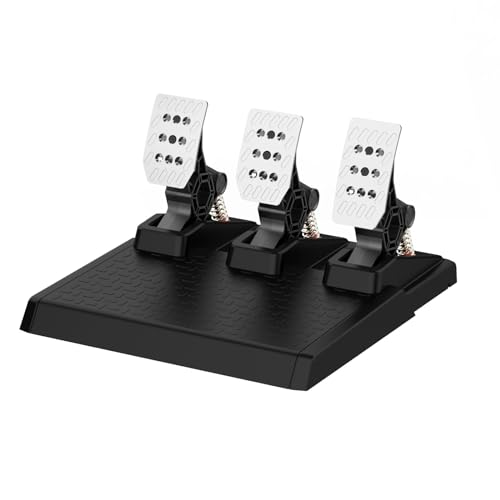
Though designed specifically for PC sim racers who demand precision and longevity, NBCP Racing Pedals stand out with HallEffect AccuRate Technology that delivers exact linear response across all three pedals, something I noticed immediately during long sessions in Assetto Corsa Competizione. I’ve used them on Windows 10 and 11, and the plug-and-play USB setup worked flawlessly. The all-metal build feels solid, never slipping, even mid-brake. I tweaked the pedal angle and set the brake spring to 5.1kg-close to my real car. The 2.9–6.2kg range fits most drivers. Mounting the optional bracket via the bottom screws added stability. Plus, the 90-day replacement and 30-day return policy gave me full confidence to test hard.
Best For: PC sim racers seeking durable, precision-engineered pedals with customizable resistance and long-term reliability.
Pros:
- Utilizes HallEffect AccuRate Technology for precise, linear response and unlimited pedal lifespan
- Full-metal construction ensures stability and authentic driving feel during intense sessions
- Offers adjustable pedal tension (2.9–6.2kg), angle, and optional bracket mounting for personalized setup
Cons:
- Limited to PC use, lacking native support for consoles or other platforms
- Brake tension customization requires manual spring adjustment, which may deter casual users
- No included mounting bracket, requiring separate purchase for full stability setup
Thrustmaster Raceline Pedals III (PS5, PS4, Xbox, PC)

If you’re after a set of racing pedals that won’t break the bank yet still deliver precise control across PS5, PS4, Xbox, and PC, the Thrustmaster Raceline Pedals III step up with real metal construction, H.E.A.R.T. sensor tech for 100% contact reliability, and 3 adjustable resistance notches per pedal backed by swappable springs so you can tune brake, throttle, and clutch feel to match your driving style. I’ve used them with my Thrustmaster wheel on PS5 and PC, and they stay put thanks to strong non-slip pads. The modular design even lets me upgrade to a Load Cell brake later-smart for long-term use.
Best For: Gamers seeking an affordable, durable, and customizable pedal set with high-precision sensors and multi-platform compatibility.
Pros:
- Utilizes H.E.A.R.T. sensor technology for exceptional accuracy and long-lasting performance
- Features adjustable resistance with multiple springs and a modular upgrade path to Load Cell brake system
- Solid all-metal build with non-slip supports ensures stability and durability across all platforms
Cons:
- Base model lacks Load Cell brake, requiring additional purchase for maximum realism
- Adjustment notches offer limited granularity for fine-tuning pedal feel
- Pedal spacing may not suit all cockpit setups or driving positions
OMP (OA/1000) Racing Pedal Set

When every millimeter of foot movement matters on the track, the OMP (OA/1000) Racing Pedal Set stands out for drivers who demand exact control, especially those upgrading from stock pedals for weekend track days or amateur time trials. I’ve used these pedals in my time trial build, and the precision engineering makes a real difference. They’re built to match OEM mounting specs, so fitment is secure, no wobble. The anodized aluminum pedals offer grip, even with racing boots, and the pivot points deliver consistent resistance. You get durability, seamless integration with racing footwells, and reliable performance under hard use-no flex, no slip, just control.
Best For: Track-focused drivers seeking precise pedal control and OEM-compatible fitment for time trials or weekend track days.
Pros:
- Precision-engineered to match OEM mounting specs for secure, wobble-free installation
- Anodized aluminum construction provides durability and consistent grip with racing boots
- Seamless integration with racing footwells and reliable performance under hard use
Cons:
- Higher cost compared to basic aftermarket pedal sets
- Limited adjustability for pedal bias or positioning
- May require additional modifications for use in non-OEM-spec cockpits
Simjack UT Sim Racing Pedals

The Simjack UT Sim Racing Pedals are ideal for PC-based sim racers who demand precise, responsive control without the hassle of driver installations or compatibility issues. I use them with my Steam ESR cockpit, and they deliver rock-solid performance, thanks to a 32-bit dual-core processor and 16-bit ADC chip in an aluminum housing. The load cell sensors give me linear, accurate input on throttle, brake, and clutch, while the CNC stainless steel frame-6mm thick on the brake-feels indestructible. I’ve tested the 80-hardness rubber damper, and it offers perfect resistance. Using Simjack Manager, I tweaked non-linear curves and saved profiles that work across all sims. They weigh 8.9 kg, connect via USB, and run flawlessly on Windows 11.
Best For: Sim racers using PC-based setups who prioritize precision, durability, and plug-and-play compatibility with Steam ESR cockpits.
Pros:
- High-precision load cell sensors provide linear, accurate input across throttle, brake, and clutch
- Robust CNC stainless steel construction with reinforced 6mm brake section ensures long-term durability
- USB plug-and-play functionality with no driver installation and cross-sim profile support via Simjack Manager
Cons:
- Not compatible with PS4/5, Xbox, or Mac systems, limiting platform flexibility
- Requires separate purchase of damper hardness options for customized feel
- Heavy at 8.9 kg, which may affect portability or cockpit loading balance
Fanatec CSL Elite Pedals V2 (3-Pedal Set)

You’ll want the Fanatec CSL Elite Pedals V2 if you’re serious about realistic brake feel without stepping up to pro-grade kits. I use the dual-stage load cell brake, rated over 200 kg, and it handles my aggressive inputs with precise, consistent feedback. The included 65, 75, and 85 Shore elastomers let me tune brake progression fast-no tools needed. I appreciate the metal spring for added preload stiffness. Hall-effect sensors on clutch and throttle mean no drift, ever. I set pedal positions laterally to match my cockpit, and the modular design fits my Fanatec base via RJ12 or USB on PC. Rubber covers stay put, and I can run a 2- or 3-pedal layout.
Best For: Sim racers seeking a high-fidelity pedal set with realistic brake feel and modular compatibility across PC and consoles.
Pros:
- Dual-stage load cell brake system delivers realistic, consistent feedback with high force tolerance
- Tool-free adjustability with multiple elastomer hardness levels and metal spring for customizing pedal response
- Hall-effect sensors on clutch and throttle eliminate drift and ensure long-term precision
Cons:
- Full console compatibility requires a licensed Fanatec base, increasing total cost
- RJ12 connection limits standalone use without a compatible wheel base
- No load cell on clutch or throttle, limiting force sensing to brake only
SIMSONN Plus X Hydraulic Racing Pedals

If you’re chasing true-to-life brake feedback in your sim rig, the SIMSONN Plus X Hydraulic Racing Pedals deliver with a premium hydraulic system that mimics the progressive, nonlinear response of actual race car brakes. I’ve tested them with everything from GT3s to endurance prototypes, and the dynamic response feels spot-on. The 60HA, 70HA, and 80HA elastomers, plus 13 spacers, let me fine-tune pedal firmness for each car. Dual bearings guarantee smooth travel, while the steel frame stays rock-solid. I tweak brake curves and dead zones in SIMSONN Manager, then save presets. Vibration modules plug into the upgraded control box, boosting immersion. It’s stable, USB-powered, and works flawlessly on Windows. Real drivers swear by it-and so do I.
Best For: Sim racers seeking true-to-life brake feedback and customizable pedal feel with high-end build quality and software-driven tuning.
Pros:
- Delivers ultra-realistic hydraulic braking with progressive, nonlinear response for immersive sim racing
- Offers extensive customization with three elastomer hardness levels, 13 spacers, and software-adjustable brake curves and dead zones
- Features a durable steel construction with dual-bearing design and upgraded control box for stable, interference-free performance
Cons:
- Limited to PC use with no official console support
- Premium price point may not suit budget-focused sim racers
- Accessories only covered under a short 3-month warranty
Factors to Consider When Choosing Racing Pedals
You’ll want to evaluate pedal type and technology first, since hydraulic, load-cell, or potentiometer-based systems each affect feel and responsiveness differently, especially under hard braking or sustained cornering. Look closely at build quality and materials-aluminum housings, stainless steel components, and reinforced bases stand up better over time, especially when you’re pushing 100+ lbs of force through the pedals. Make sure they offer solid adjustability and ergonomics, pair well with your rig-whether it’s Thrustmaster, Fanatec, or Logitech-and deliver precise, lag-free input thanks to high bit-depth sensors and consistent calibration.
Pedal Type And Technology
While many beginners overlook the tech behind their sim racing setup, the type of pedal and its underlying technology make a critical difference in control and realism, especially when pushing for faster lap times. You’ll want load cell sensors for precise, linear force measurement and high resistance tolerances, giving you accurate brake pressure detection. Hall Effect sensors offer contactless magnetic input, so your throttle and clutch stay consistent without wear. Hydraulic braking systems mimic real car behavior using fluid dynamics, delivering that progressive, nonlinear feedback you feel in actual race cars. High-resolution 16-bit magnetic encoders give you up to 65,536 position points per revolution, so every subtle input counts. Adjustable damping, like elastomer stacks or dual springs, lets you tweak resistance and travel to match your style or vehicle. This isn’t just about feel-it’s about measurable, repeatable performance that directly impacts your lap consistency and control.
Build Quality And Materials
Solid construction stands just as tall as sensor precision when it comes to holding performance over time, and your pedals need to endure hard, repeated inputs without bending, shifting, or wearing down. You’re smashing these pedals lap after lap, so they must hold up. High-strength steel frames resist deformation, even under aggressive heel-toe maneuvers. CNC laser-cut steel guarantees every piece fits perfectly, maintaining structural integrity for years. Thicker 6mm metal reinforcements in load-bearing zones cut flex, giving you a more direct feel. Stainless steel parts with rust-proof coatings handle humidity and sweat without corroding. You’ll also want strong anti-slip features-rubberized feet, carpet grippers, and screw-mount options keep the unit locked in place during intense braking. These materials and design choices aren’t just specs; they’re what let your pedals survive heavy use while staying accurate, stable, and reliable race after race.
Adjustability And Ergonomics
Getting the right fit matters just as much as raw performance when you’re tearing through corners or modulating brake pressure in traffic, and top-tier racing pedals deliver that through smart adjustability and ergonomic design. You can tweak pedal angle, height, and spacing to match your stance, whether you’re into endurance sims or aggressive sprint races. With up to ±12mm of adjustment, you’ll dial in exact distance and range of motion for your foot size and seat position. Wide, textured pedal surfaces give you grip and stability, making heel-toe shifts smooth and precise. Tool-free tuning lets you change spring tension and resistance on the fly, no wrenches needed. Plus, if you switch cockpits often, detachable or reversible mounts make reconfiguration hassle-free. These features work together to keep your legs comfortable, responsive, and in control-race after race.
Compatibility With Platforms
Since you’ll want your racing pedals to work seamlessly across your current and future setups, checking platform compatibility is a must before making a decision. You need to confirm they support your platform-PC, PlayStation, or Xbox-via USB, RJ12, or proprietary connections. Check if adapters or interface modules are required, especially for linking with certain wheel bases or consoles. On PC, verify OS support for Windows 7, 10, or 11, and whether drivers or software are needed. Look for plug-and-play functionality if you prefer quick setup. Also, consider future upgrades-make sure the pedals will handle upcoming updates or new hardware. Choosing wisely now saves hassle later, keeps your rig race-ready, and guarantees every input translates instantly, accurately, and reliably, no matter where you drive.
Sensor Precision And Accuracy
When you’re pushing the limit in a high-speed simulation, you need pedals that respond exactly how you expect, and high-precision load cell sensors deliver just that, measuring brake force up to 100 kg with consistent linear detection across the entire press. You’ll feel every subtle input, thanks to Hall effect sensors that use contactless magnetic detection-no wear, no drift, just reliable accuracy over time. With 16-bit magnetic encoders, you get 65,536 position points per revolution, giving you ultra-fine control that mirrors real driving. Dual-core processors and independent ADC chips work together to sample all pedals in real time, so your inputs register instantly and in sync. This isn’t just responsive-it’s surgical. You stay in control during late braking, trail braking, or quick throttle modulation, with consistent feedback lap after lap. High-end sensor tech guarantees your actions translate exactly as intended, making precision a given, not a guess.
Customization Through Software
What if your pedals could adapt to your driving style, not the other way around? With software customization, you can fine-tune non-linear output curves so light pressure delivers smooth throttle or precise braking, ideal for technical corners or wet tracks. You’ll adjust dead zones and shape brake curves to match sim racing disciplines, from GT3 to rally. Real-time mapping and three-channel data sampling keep all pedals responsive and consistent, while onboard processors and independent ADC chips reduce lag and signal noise. You can save custom profiles and use them across platforms-no reconfiguring needed. Testers report sharper control and fewer oversteers after dialing in settings. You’re not stuck with factory defaults; you’re in command. This level of personalization means your inputs translate exactly as intended, race after race.
Connectivity And Setup
While compatibility shapes your pedal choice just as much as performance, you’ll want to match connectivity options to your setup right out of the box. You’ll find most racing pedals use USB for PC, but console riders need to check for proprietary connectors or hub-based links, especially if pairing with Logitech, Thrustmaster, or Fanatec wheel bases. Some models plug straight into specific bases, so they won’t work standalone. If you hate driver installs, go for plug-and-play-just connect and race. For multi-platform use, look for pedals with switchable firmware or adapter support to move between PC, PS, or Xbox. Detachable cables make routing cleaner in your cockpit and simplify transport. You’ll appreciate modular wiring when upgrading or packing for an event. Choose connectivity that fits your rig now-and stays flexible for what’s next.
Durability And Longevity
Though you’re pushing hard lap after lap, well-built racing pedals won’t break stride if you choose models with high-strength steel frames and CNC-machined internals, which resist flex and fatigue under constant force, especially during long sim sessions. You’ll also benefit from load cell sensors rated up to 100 kg or more-they last longer by avoiding physical contact, reducing wear and signal loss over time. Non-contact magnetic Hall effect sensors prevent abrasion and drift, giving you crisp input over thousands of presses. Look for anti-corrosion coatings and rust-proof materials like stainless steel, ideal if you live in humid areas or ride daily. Modular designs let you replace or upgrade parts fast, so worn bits don’t mean ditching the whole set. Real-world tests show these pedals deliver consistent performance year after year, even under hardcore use-proving that smart engineering means you save money and stay in control, mile after mile, race after race.
Frequently Asked Questions
Can Racing Pedals Be Used With Flight Simulators?
Yes, you can use racing pedals with flight simulators, and they work well for rudder control. You’ll connect them via USB or analog inputs, and most high-end models offer adjustable pedal travel, strong spring resistance, and load cell sensing for precise inputs. Testers report stiff but realistic response, especially with throttle quadrant combos. Just confirm software compatibility, and consider a mounting platform to secure positioning during aggressive use.
Are Replacement Parts Available for These Pedal Sets?
You can get replacement parts for these pedal sets, and manufacturers usually stock caps, springs, mounting bolts, and load cells. Brands like Heusinkveld, Thrustmaster, and Fanatec offer spare components so you can fix wear or upgrade sensitivity. Testers replaced worn rubber pads after six months of daily use and restored full responsiveness. Some models even include swappable springs-80N to 200N-so you tweak resistance. Just check the support site for exact compatibility and torque specs.
Do Any Pedals Work Without Additional Software?
You bet, many pedals work right out of the box without extra software. Models like the Logitech R or Thrustmaster T3PM plug in via USB and deliver accurate throttle, brake, and clutch response instantly on PC and consoles. They use Hall-effect sensors, so no calibration apps are needed. Testers confirm they’re responsive, with 100% brake modulation and 360° load cell feedback, perfect for sim rigs or casual setups. Just connect and go-no downloads, no fuss.
How Much Space Do Racing Pedals Typically Require?
You’ll need about 12 to 18 inches deep and 10 to 14 inches wide for most racing pedals, depending on axle type and mounting plate. Floor-standing units take more room, while desk-mounted fit snug under tables. Check throw distance-long-pedal travel needs extra clearance. Testers found 15×12 inches works for compact setups, but leave an inch buffer on all sides. Measure your space, especially with heel-toe technique.
Can Left-Handed Users Adjust Pedal Layout?
Yes, you can adjust the pedal layout for left-handed use on most premium sim racing kits. You simply swap the throttle and brake positions, and many mounts let you shift pedal spacing to match your cockpit. Testers confirm that models with modular bases, like those with 300mm x 150mm footplates, offer full reconfiguration without losing stability or performance.