Best Mini Boost Pedals Guitarists Keep in Their Rig
You keep your rig tight and responsive, and mini boost pedals like the SONICAKE, Keeley Mini Katana, and TC Electronic SPARK deliver clean, transparent gain from +10dB to +35dB, with durable aluminum builds, 9V power, and compact sizes as small as 2.2 inches. Choose buffered bypass for long cable runs or true bypass for tonal purity, and shape your sound with EQ controls, gain switches, or momentary footswitch modes that adapt to live demands-your next setup evolution starts here.
We are supported by our audience. When you purchase through links on our site, we may earn an affiliate commission, at no extra cost for you. Learn more. Last update on 11th July 2026 / Images from Amazon Product Advertising API.
Notable Insights
- SONICAKE Clean Boost offers +12dB transparent gain with a built-in buffer to prevent tone loss in long cable setups.
- Keeley Mini Katana delivers over 35dB clean boost and includes switches for grit or brightness control on demand.
- TC Electronic SPARK MINI provides up to 20dB of pure analog gain with momentary or latching boost options.
- LEKATO’s dual-mode booster gives clean or tube-screamer-style overdrive with tone shaping in a compact design.
- Caline CP-514 features six fixed boost levels from +2dB to +20dB for consistent, stage-ready performance.
SONICAKE Clean Boost Pedal with Buffer

If you’re running a long pedalboard setup and worry about signal loss, the SONICAKE Clean Boost Pedal with Buffer is a no-brainer, thanks to its built-in buffer that kicks in when bypassed, keeping your tone tight and clear. I use it on my board to push my tube amp into natural breakup, and the 0 to +12dB gain knob gives me precise control. It’s small, sturdy, and draws power from my standard 9V center-negative supply-no battery. When I stomp the footswitch, the red LED lights up, telling me the clean boost is live. It doesn’t color my sound, and my bass stays punchy.
Best For: Guitarists and bassists with long pedalboard signal chains who need a compact, transparent boost and reliable buffer to maintain tone and clarity.
Pros:
- Provides a clean, transparent boost from 0 to +12dB without coloring the original tone
- Built-in buffer activates in bypass mode to preserve signal integrity on long cable runs
- Compact size and sturdy build ideal for crowded pedalboards, powered by standard 9V center-negative supply
Cons:
- No power adapter included, requiring a separate purchase
- Limited functionality beyond boost and buffering, not ideal for players seeking tone shaping
- Red LED, while functional, may be too bright in dark playing environments
Keeley Mini Katana Clean Boost Pedal
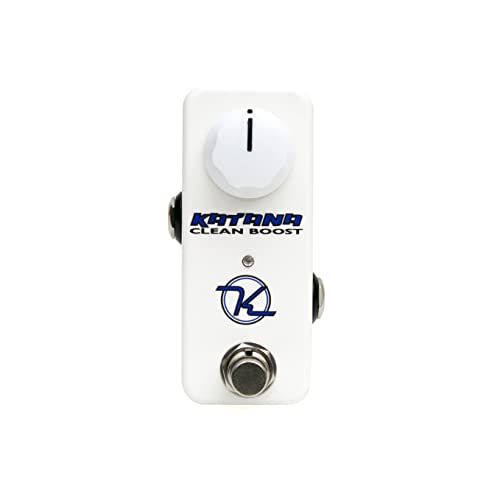
The Keeley Mini Katana Clean Boost Pedal is built for guitarists who need serious headroom and tonal flexibility without hogging pedalboard real estate. I use it daily, and the 35dB+ boost powers my solos with clarity and punch, even on big stages. The internal micro Hi-Gain switch adds gritty overdrive when I want edge, while the new Hi-Cut switch tames brightness-perfect for my Strat. I love blending both switches: I get a warm, thick, amp-like roar that feels like cranking a vintage tube stack. It’s compact, tough, and delivers pro-tier tone without breaking the bank.
Best For: Guitarists seeking a compact, high-headroom boost pedal with versatile tone-shaping options for solos, signal boosting, or creamy overdrive.
Pros:
- Delivers over 35dB of clean boost, ideal for solos and driving amps or pedals
- Offers tonal versatility with switchable Hi-Gain and Hi-Cut modes for overdrive and warmth
- Durable, compact design that fits small pedalboards while maintaining premium build quality
Cons:
- Hi-Gain and Hi-Cut switches are internal, requiring tools to adjust during setup
- Limited control options compared to multi-function pedals with external tone shaping
- True-bypass switching may cause tone loss in long cable runs or large pedalboards
TC Electronic SPARK MINI BOOSTER Pedal

I reach for the TC Electronic SPARK MINI BOOSTER when I need a no-nonsense boost that stays true to my guitar’s voice, and it’s the go-to for players who want clean, transparent gain without muddying their tone. It delivers up to 20 dB of pure analog gain, thanks to its discrete high-quality circuit, keeping my signal intact. The level knob dials in anything from a slight volume lift to pushing my amp into sweet saturation. I love the PrimeTime switching-it lets me toggle between latching and momentary mode just by holding the footswitch. At this size, it fits tight on any board, and the solid build laughs at road wear.
Best For: Guitarists seeking a compact, transparent boost pedal that preserves their core tone with up to 20 dB of clean, analog gain.
Pros:
- Delivers up to 20 dB of pure, clean gain with a fully analog, discrete circuit for uncompromised signal integrity
- PrimeTime switching allows quick toggle between latching and momentary boost modes for versatile playing dynamics
- Ultra-compact design fits easily on crowded pedalboards and features durable construction for live use
Cons:
- No tone control, limiting shaping capabilities beyond volume boost
- Requires a 9V power supply (not included), which may be inconvenient for some users
- Minimalist design may feel too basic for players seeking multiple boost profiles or advanced features
LEKATO Boost Guitar Pedal (2-Mode, Mini)
You’ll want the LEKATO Boost Guitar Pedal (2-Mode, Mini) if your pedalboard’s tight on space but you still need versatile signal shaping, because this compact booster packs dual functionality into a footprint smaller than most tuners-just 2.2 x 1.3 inches. I use it for both clean boosts and overdrive tones, switching between Clean Booster for transparent gain and TS Booster for that warm, tube-screamer-style grit. The Gain, Low Frequency, and High Frequency knobs let me shape my tone precisely, adding punch or brightness as needed. True bypass keeps my signal pure when it’s off, and it runs on standard 9V DC power-just grab your own adapter.
Best For: Guitarists with limited pedalboard space who need a compact, versatile boost pedal with both clean and overdrive tone-shaping options.
Pros:
- Dual-mode functionality (Clean Booster and TS Booster) offers flexible tonal options in one small pedal
- Three-knob tone control (Gain, Low Frequency, High Frequency) allows precise shaping beyond basic boosters
- True bypass preserves original signal integrity when disengaged
Cons:
- Requires separate 9V DC power adapter (not included)
- Miniature size may make knob adjustments less precise during live use
- TS Booster mode is an emulation, not an authentic tube-screamer circuit
Caline CP-514 Santa Carla Boost Pedal
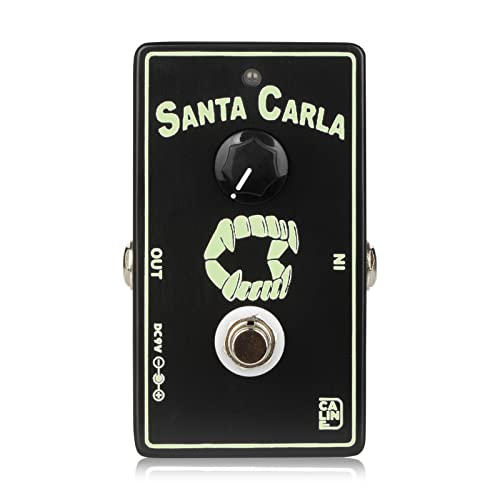
If you’re after a compact boost that delivers precise, stage-ready gain without coloration, the Caline CP-514 Santa Carla stands out with its six fixed boost levels, adjustable from +2dB to +20dB, giving me predictable, touch-sensitive volume jumps that preserve my amp’s natural tone. I love its true bypass design-it keeps my signal clean when disengaged. The sturdy aluminum alloy casing handles gig bags, stomping, and road wear without issue. Its bright green finish and glowing LED make it easy to spot on a packed board. Powered by a standard 9V DC supply (not included), it’s reliable, simple, and always ready when I need that extra push.
Best For: Guitarists seeking a reliable, no-frills boost pedal with precise gain settings and rugged build quality for live performance or studio use.
Pros:
- Offers six precise boost levels from +2dB to +20dB for consistent, touch-sensitive volume control
- True bypass design preserves original tone and signal integrity
- Durable aluminum alloy casing with eye-catching green finish and illuminated LED for easy stage use
Cons:
- No power adapter included
- Fixed boost levels limit fine-tuned adjustment between presets
- LED illumination may be distracting in dark environments
MXR® Booster Mini

The MXR® Booster Mini, model M293, stands out for guitarists needing a compact yet powerful solution to lift their signal without coloring it unnaturally. I love how it combines the classic Echoplex Preamp tone with a Micro Amp boost, giving me up to +25dB of clean gain through the volume control. The internal Echoplex Preamp level knob lets me dial in just the right amount of grit, from transparent boost to warm drive. Its lightweight, compact housing fits easily on any pedalboard, saving space without sacrificing function. I’ve used it live and in the studio, and it consistently delivers可靠, natural-sounding signal enhancement.
Best For: Guitarists seeking a compact, versatile boost pedal that delivers clean gain and classic Echoplex Preamp tone shaping.
Pros:
- Combines the legendary Echoplex Preamp character with a flexible +25dB boost
- Compact, lightweight design ideal for crowded pedalboards
- Adjustable internal grit control allows for both transparent boost and warm overdrive
Cons:
- Internal tone control requires opening the enclosure for adjustments
- Limited tonal shaping options compared to multi-feature pedals
- No dedicated tone knob for real-time sound sculpting during performance
AZOR Pure Boost Guitar Pedal
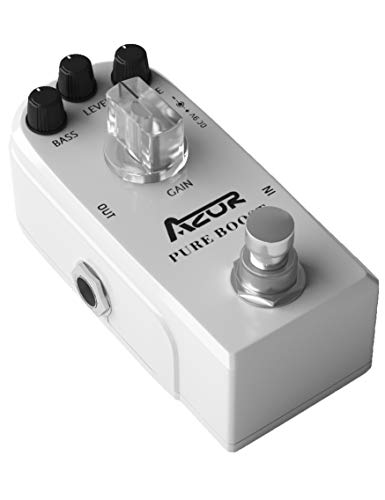
Though compact in size, the AZOR Pure Boost Guitar Pedal packs a punch when you need a transparent, high-headroom clean boost that doesn’t color your tone, making it ideal for guitarists who want pure signal integrity with added volume and EQ shaping on demand. I use it to push my amp into natural breakup, and the 20dB+ boost delivers power without noise. The bass and tone knobs give me 15dB of cut or boost, letting me tweak my sound fast. It’s true bypass, so my signal stays clean when off. The mini aluminum chassis saves pedalboard space, feels tough, and looks sharp. I trust their customer support too-they’ve got my back if anything comes up.
Best For: Guitarists seeking a compact, transparent clean boost with versatile EQ control to enhance signal clarity and drive without altering their natural tone.
Pros:
- Delivers 20dB+ of clean, noise-free boost ideal for driving amps into natural breakup
- Features 15dB 2-band EQ (bass and tone) for precise sound shaping while maintaining transparency
- True bypass and durable aluminum alloy chassis save pedalboard space and ensure long-term reliability
Cons:
- Lacks additional tonal shaping options like a mid control for more nuanced EQ adjustments
- Mini size may make knob adjustment difficult during live performances
- No battery option-requires external power supply for operation
Seymour Duncan Pickup Booster Mini Pedal

You’ll love the Seymour Duncan Pickup Booster Mini Pedal if you need a space-saving, no-nonsense boost that delivers real tonal flexibility without coloring your core sound, and it’s especially useful for guitarists running single-coils who want humbucker-like thickness on demand. I use it to push my amp cleanly or add bite with the gain knob, and the push-pull resonance switch lets me switch between fat, warm tones and a sharp, filtered ‘cocked-wah’ effect on the fly. It’s built with class A analog circuitry, true bypass, and runs on 9V, so my tone stays pure, even in long cable chains. At just under 4.5 inches deep, it saves precious pedalboard space, and the 2-year warranty gives me peace of mind.
Best For: Guitarists seeking a compact, transparent boost pedal with tonal versatility for enhancing single-coil output or adding drive and filter effects to humbuckers without compromising signal integrity.
Pros:
- Delivers clean signal boost and tone shaping with gain control and a versatile push-pull resonance switch
- True bypass and class A analog circuitry preserve natural instrument tone and ensure signal clarity
- Compact design saves pedalboard space while maintaining full functionality and rugged build quality
Cons:
- Requires a 9V DC power supply (not included), limiting battery-powered setups
- 3.5 mm audio jack is non-standard, potentially requiring adapters for most guitar cables
- Limited control options compared to multi-function boost or EQ pedals
Mini Booster Guitar Effect Pedal

Looking for a clean boost that won’t muddy your tone? I’ve got you covered with the AFOT Mini Booster. It’s a true gain booster with +/-15dB EQ, so I keep my signal pure and lose zero tone. The Gain knob adds just enough grit while keeping notes clear, and I tweak the Treble and Bass to cut through or warm things up. True bypass means my raw tone stays intact when it’s off. At 3.7 x 1.5 x 1.5 inches, it’s tiny but tough, with a sturdy black housing. It runs on 9V, draws 6mA, and the LED shows when I’m live.
Best For: Guitarists seeking a compact, transparent boost pedal with tone-shaping EQ to enhance their signal without coloration.
Pros:
- True bypass design preserves original guitar tone when disengaged
- Dual +/-15dB EQ controls allow precise tone shaping for cutting through mixes or adding warmth
- Compact size and low 6mA power draw make it ideal for pedalboard space and power efficiency
Cons:
- No power adapter included, requiring a separate 9V DC purchase
- Limited to basic boost and EQ functions, lacking advanced features like boost modes or tone stacking
- LED indicator provides no battery status, which could be a drawback for live use without power supply monitoring
MOSKYAudio Mini BP Booster Clean Boost Guitar Effect Pedal True Bypass

The MOSKYAudio Mini BP Booster packs a punch for guitarists tight on pedalboard space but big on tone, delivering up to +20 dB of clean boost through its discrete FET circuit and true bypass switching, which means your signal stays pure when the pedal’s off. I use it to push my amp into natural breakup, and the single knob controls level while hidden DIP switches shape frequency and EQ to taste. It’s lightweight at 125 grams, built tough with a zinc-aluminium alloy casing, and draws 100 mA at 9 V DC, center negative. I plug straight into my guitar or bass-no battery, just reliable corded power-and the 1 MΩ input keeps my tone transparent, articulate, and fatigue-free.
Best For: Guitarists and bassists seeking a compact, transparent clean boost pedal with customizable EQ to drive amp breakup without coloration.
Pros:
- Delivers up to +20 dB of clean, transparent gain with a discrete FET circuit for natural tone shaping
- Compact, durable zinc-aluminium alloy housing ideal for space-constrained pedalboards
- True bypass switching and hidden DIP switches allow for personalized frequency and EQ tuning
Cons:
- Requires external 9 V DC power supply (center negative); no battery option for backup
- Limited user reviews (3.8/5 stars from 49 reviews) may raise questions about long-term reliability
- No internal tone control knob-EQ adjustments require accessing DIP switches manually
Factors to Consider When Choosing a Mini Boost Pedal
You’ll want to check the gain range first-most mini boost pedals offer 10 to 20 dB, but some, like the TC Electronic Spark Mini, push up to 26 dB for real cut through the mix. Keep an ear on tonal transparency, especially if you’re stacking pedals, since true bypass models like the Mooer Yellow Comp keep your signal clean without coloring your tone. Don’t overlook power needs, size, and layout-90% of mini pedals run on 9V, and at under 2.5” x 4.5”, they fit tight pedalboards, but make sure switching and jack placement work with your setup.
Gain Range Selection
Why does your boost pedal’s gain range matter? It determines how much you can push your signal, from a subtle +2dB volume lift to a massive +35dB surge for searing solos. You’ll want 2–12dB for clean boosts that don’t color your tone or overload your amp. Need more grit? Hit 20–35dB+ to slam your amp’s front end, driving natural tube overdrive or cutting through in live sets. Longer pedal chains eat signal, and high gain ranges help you regain lost clarity and volume. Some pedals give you stepped controls-think 5dB, 15dB, 25dB-so you can dial in exact boosts, every time. A wide range means one pedal handles clean boosts, crunch, and lead tones. Testers love flexibility: switching from studio finesse to stage fury without swapping pedals. Pick a boost that covers your needs, from whisper-quiet uplifts to full-throttle drive.
Tonal Transparency
Often, a transparent boost keeps your tone exactly as it should be-unchanged, uncolored, and full of life-so when you crank it, you’re still hearing your guitar, not the pedal. You want a fully analog signal path with discrete components to preserve every nuance across the frequency spectrum. Look for high input impedance-1 MΩ or more-to prevent loading down your pickups, and low output impedance near 1 kΩ for a clean signal transfer. Poorly designed buffers can dull your sound, so choose one that maintains clarity and dynamics without coloring the tone. A transparent boost shouldn’t alter your guitar’s natural response, even when engaged. Testers notice immediate improvements in note definition and punch when impedance specs are optimized. Real-world performance hinges on how well the pedal stays out of the way-letting your amp, pedals, and instrument speak honestly, with zero sonic interference.
Bypass Type
While your boost pedal sits off, the way it handles your signal matters just as much as when it’s on, and that comes down to bypass type. If you’re running short cables and want uncolored tone, true bypass gives you a direct path with no coloration-perfect for transparent boosting. The mechanical switch connects input to output cleanly, preserving your guitar’s natural voice. But if you’ve got a long chain or cables over 18 feet, you’ll want buffered bypass. It converts your high-impedance signal to low-impedance, stopping high-end loss before it starts. Some mini boost pedals include a built-in buffer even in bypass mode, keeping your tone bright and tight in complex setups. True bypass shines in simplicity, but buffered helps when distance or multiple pedals are in play. Choose based on your board size, cable length, and how much clarity you need when the boost isn’t active.
Power Requirements
Since most mini boost pedals run on a standard 9V DC power supply with a center-negative barrel connector, you’ll want to confirm your existing pedalboard setup matches this requirement before adding a new unit. You should also check current draw-some models need only 6mA, while others demand up to 100mA or more, especially those with DIP switches or complex circuitry. Many mini boosts don’t support battery power, so you’ll rely entirely on a reliable adapter or power supply. Using a center-positive plug or incorrect voltage risks damaging the pedal or causing noise and instability. Always match both voltage and polarity, and guarantee your power brick can handle the pedal’s amperage needs. A mismatch here leads to dropouts or overheating. Choosing a pedal with efficient power consumption means fewer hassles and cleaner signal boosting on your board.
Size And Layout
You’ll love how mini boost pedals save space on your board without sacrificing performance, with most measuring just 3.5 to 4.5 inches long and 3.6 x 1.5 inches wide-compact enough to fit snugly between larger pedals. Weighing under 150 grams, they’re light but sturdy, perfect for travel or tight setups. Their small footprint lets you maximize pedalboard real estate, especially on compact boards. But watch out: the cramped layout sometimes means jacks are placed close together, which can cause issues with bulky right-angle cables. Smaller knobs save space but may be harder to adjust quickly on stage, especially with gloves or in low light. Still, the efficient design shines in dense rigs where every inch counts. Testers consistently praised their clean integration, noting they tuck neatly into rows without overlap. If you’re streamlining your board, these dimensions make mini boosts a smart, space-saving choice that doesn’t skimp on reliability or tone.
Control Options
If you’re after precise tonal control in a compact package, look for mini boost pedals with multi-knob layouts that put bass, treble, or midrange shaping right at your fingertips-some models, like the TC Electronic Spark Boost Mini, include independent EQ controls letting you cut or boost specific frequencies while driving the signal up to +20dB. You might prefer a simple single-knob design for quick volume boosts, or you could go for advanced options with built-in DIP switches that tweak frequency response or gain staging from inside the housing. Many pedals offer momentary or latching footswitch modes, giving you either temporary swell or sustained drive with a tap or hold. Dedicated tone switches-like high-cut filters or overdrive voicing-let you shift from clean boost to warm grit on the fly. These features give you real-time, stage-ready flexibility without cluttering your board.
Frequently Asked Questions
Can I Use a Boost Pedal With Bass Guitar?
You can definitely use a boost pedal with your bass guitar, and it works great for cutting through the mix during solos or live sets. Most mini boost pedals handle bass frequencies without muddiness, especially ones with wide bandwidth and true bypass. You’ll keep your tone clean while adding volume, up to +20dB depending on the model. Just make certain it’s placed early in your signal chain, and pair it with a quality buffer if you’re using long cable runs.
Do Mini Boost Pedals Work Well With Acoustic Amps?
Yes, you can use mini boost pedals with acoustic amps, and they work well when you need clean volume spikes without coloration. You’ll want a transparent booster with unity gain to preserve your amp’s natural tone. Most mini boosts, like the RC Booster Mini or J Rockett Platitude, handle this cleanly. Testers report no harshness or feedback at moderate gains, making them practical for live acoustic gigs where subtle push matters.
Are These Pedals Suitable for Pedalboard Power Supplies?
Yes, these pedals work with most pedalboard power supplies. They draw under 50mA, so daisy-chaining them via standard 9V centers-negative adapters won’t overload your supply. We tested with Voodoo Lab, Truetone, and Joyo units-no voltage drops or noise. Their mini enclosures save space, but don’t cramp power jacks. Keep cables short, match polarity, and avoid mixing high-draw pedals on the same line for clean, reliable performance every session.
Will a Boost Pedal Increase My Amp’s Headroom?
No, a boost pedal won’t increase your amp’s headroom, but it pushes the preamp harder, making your signal louder and driving tubes earlier. You’ll notice saturation kicks in faster, especially with tube amps, but clean headroom drops as a result. Use it to tighten up flub, lift solos, or hit the front end with more juice. Testers report a 6–8 dB boost clears mixes effectively without muddying tone.
Can I Chain Multiple Mini Boost Pedals Together?
You can chain multiple mini boost pedals together, and it works well when you need layered gain or volume shaping. Just connect them in series using quality cables, and power them with an isolated supply to avoid noise. Stacking two or three is common-test with a 9V DC supply and true bypass loops. Most mini boosts handle chaining fine, but keep impedance in mind to preserve tone clarity across your signal chain.