Best Low Pressure Tire Gauges for Pinpoint Accuracy
You need pinpoint accuracy, so grab the JACO Elite-it hits 0–15 PSI with ±1.5% NIST-tracked precision, a glow dial, 360° swivel chuck, and built-in bleeder for fine-tuning ATV or bike tires. For dual-use durability, Tusk’s pair gives 1–20 PSI range, brass internals, and trail-ready toughness. Pencil styles like WYNNsky or DEWALT offer lightweight, instant-read convenience at ½ lb increments, while the ETENWOLF T300 digital brings ±1 PSI accuracy and LED light for night checks, each proving reliable where every pound matters on soft terrain. More insights wait just ahead.
We are supported by our audience. When you purchase through links on our site, we may earn an affiliate commission, at no extra cost for you. Learn more. Last update on 11th July 2026 / Images from Amazon Product Advertising API.
Notable Insights
- JACO Elite offers ±1.5% accuracy with a NIST-accredited brass gauge and reading lock for precise low-pressure measurements.
- ETENWOLF T300 digital gauge provides ±1 PSI accuracy with AI chip and thermal compensation for stable, repeatable readings.
- Analog gauges featuring brass Bourdon tubes ensure long-term accuracy and sensitivity in 0–20 PSI ranges.
- Internal dampers in high-precision gauges reduce needle bounce, preventing misreads by up to 1 PSI.
- BBTO and DEWALT pencil gauges deliver fine ½ PSI increments for accurate adjustments in compact formats.
JACO Elite Low Pressure Tire Gauge – 15 PSI
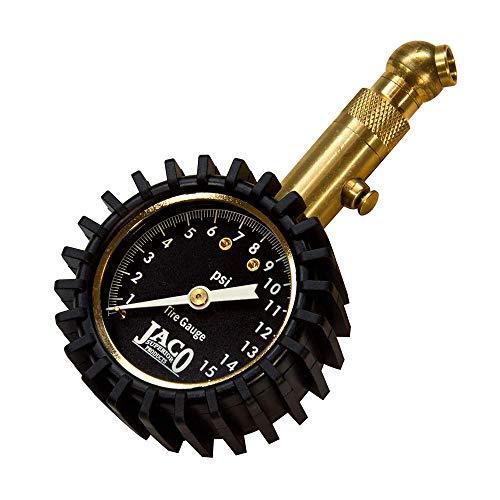
If you’re running low tire pressures on an ATV, dirt bike, or utility tractor-where every PSI matters- the JACO Elite Low Pressure Tire Gauge is my go-to tool for fast, reliable readings. It’s accurate to ±1.5% at an NIST-accredited lab, so I trust it before every ride. The 0–15 PSI brass gauge has a glow-in-the-dark 2″ dial, locks readings until reset, and features a 360° swivel chuck, so I can check pressure from any angle. I use the built-in bleeder valve to fine-tune pressure on the spot. Its thick brass stem and rubber guard survive drops, dirt, and vibration. No batteries, just precision-plus, it’s got a lifetime warranty.
Best For: Off-road and utility vehicle enthusiasts who need precise, durable, and battery-free low-pressure tire readings for ATVs, dirt bikes, tractors, and similar vehicles.
Pros:
- Highly accurate ±1.5% at an NIST-accredited lab with rugged brass construction and a lifetime warranty
- Glow-in-the-dark 2″ dial with reading lock and 360° swivel chuck for easy, precise measurements in any condition
- Built-in bleeder valve and durable rubberized guard make it practical, long-lasting, and user-friendly in tough environments
Cons:
- Limited to 0–15 PSI range, making it unsuitable for standard passenger vehicles or higher-pressure applications
- Heavier brass build may feel bulky for users preferring lightweight, compact gauges
- Higher price point compared to basic tire pressure gauges with similar range
Tusk Low Pressure Tire Gauge (Pair)

I rely on the Tusk Low Pressure Tire Gauge (Pair) when I need precise readings for my ATV and dual-sport motorcycle tires, and it’s the best choice for riders who regularly tackle technical trails where tire pressure makes or breaks traction. These gauges read 1–20 psi in ½-pound increments, so I can spot small changes fast. They’re built tough, using high-quality materials that handle trail abuse and weather. Lightweight and compact, I keep one in my tool kit and one in my garage. The pair setup lets me quickly check front and rear tires without fumbling. I’ve used mine for months-no leaks, no errors. For serious riders who demand accuracy, this set delivers.
Best For: Off-road riders who need precise, durable, and portable tire pressure gauges for ATVs, UTVs, and motorcycles.
Pros:
- Delivers accurate readings from 1–20 psi in ½-pound increments for optimal traction tuning
- Durable, high-quality construction withstands harsh trail conditions and prolonged use
- Compact, lightweight design with a pair included for convenient front/rear tire checks
Cons:
- Limited to low-pressure applications, not suitable for higher PSI vehicle tires
- Analog design lacks digital precision or backlighting for low-light use
- No protective case included, risking damage during transport
BBTO 2-Pack Low Pressure Tire Gauges

The BBTO 2-Pack Low Pressure Tire Gauges is my go-to choice when I need precise, reliable readings for off-road and specialty tire applications, especially for setups where standard gauges fall short. I use them on my ATV and golf cart, where accurate 0–20 PSI measurements matter, and they deliver every time-calibrated in ½ lb, 5 kPa, or 0.05 bar increments. At 5.6 inches, they’re compact enough for my pocket or tool belt. The aluminum-coated body resists rust, fading, and drops. I just press the chuck to the valve, read the extended scale, then cap and stow-simple, fast, durable, and spot-on accurate.
Best For: Enthusiasts and professionals needing precise low-pressure tire measurements for off-road vehicles, specialty equipment, and recreational vehicles like ATVs, golf carts, and air springs.
Pros:
- Accurate readings in ½ lb, 5 kPa, and 0.05 bar increments with calibration from 1–20 PSI for reliable low-pressure monitoring
- Compact, 5.6-inch pencil-style design with durable aluminum coating that resists rust, fading, and impacts for long-term field use
- Simple push-to-read operation with extendable scale plate for quick, tool-free measurements and easy storage
Cons:
- Limited to low-pressure applications (0–20 PSI), making it unsuitable for standard car or truck tires
- Analog design may be less precise than digital gauges for users who prefer backlit displays or fine resolution
- Chuck mechanism may wear over time with frequent use, potentially affecting seal and reading accuracy
WYNNsky Low Pressure Pencil Tire Gauge (1-20 PSI)

This slim, pocket-friendly pencil gauge nails low-end accuracy, making it my go-to for dialing in 1–20 PSI on golf carts, ATVs, and air springs where every half-pound matters. I love how it’s built with a chrome-plated zinc head and aluminum tube-lightweight at just 1 ounce, yet tough enough to last. It runs without batteries, giving me instant, reliable readings the second I press it onto a valve. Calibrated in precise 1/2 lb increments, it’s perfect for low-pressure rides like trail ATVs or lawn tractors. Over 1,000 users rate it 4.6 stars, and I see why-it’s accurate, simple, and durable, ranking in Amazon’s Top 100 Automotive tools.
Best For: Enthusiasts and owners of low-pressure vehicles like golf carts, ATVs, and lawn tractors who demand precise, portable, and durable tire pressure measurement from 1–20 PSI.
Pros:
- Highly accurate analog readings calibrated in 1/2 lb increments, ideal for sensitive low-pressure applications
- Durable aluminum and chrome-plated zinc construction that’s lightweight (1 oz) and built to last
- Battery-free, instant-read design with a compact pencil form factor for easy portability and storage
Cons:
- Limited to low-pressure use (1–20 PSI), making it unsuitable for standard car or truck tires
- Analog pencil design may be less intuitive or slightly less precise than digital gauges for some users
- No protective cap included, potentially exposing the gauge tip to damage when carried in pockets or toolbags
DEWALT Low Pressure Pencil Gauge (0-20 PSI)

Built like a precision tool for off-road enthusiasts who demand accuracy in every psi, the DEWALT Low Pressure Pencil Gauge (0–20 PSI) is my go-to for dialing in tire pressure on ATVs, UTVs, and turf equipment-especially when crawling over rocky trails or mowing sensitive grass surfaces where even 2 or 3 pounds can make a difference. I love its slim, pencil-style body with a handy pocket clip-keeps it within reach at all times. The aluminum chuck head feels rugged, seals well, and the slide indicator delivers clear, repeatable readings every time. Its 0–20 PSI range nails low-end precision, and the deflation button lets me fine-tune pressures quickly, which is a game-changer when I’m pre-ride checking or adjusting on the trail.
Best For: Off-road enthusiasts and professionals who need precise low-pressure tire measurements for ATVs, UTVs, and turf equipment.
Pros:
- Slim, pencil-style design with a clip for easy portability and quick access
- Accurate slide indicator and durable aluminum chuck head for reliable, consistent readings
- Built-in deflation button allows for precise pressure adjustments on the go
Cons:
- Limited to low-pressure ranges (0–20 PSI), making it unsuitable for standard vehicle tires
- Slide mechanism may require occasional cleaning to maintain smooth operation
- No protective cap, leaving the gauge tip exposed when carried
Longacre 52-52034 0-15 PSI Tire Pressure Gauge, 2 Inch
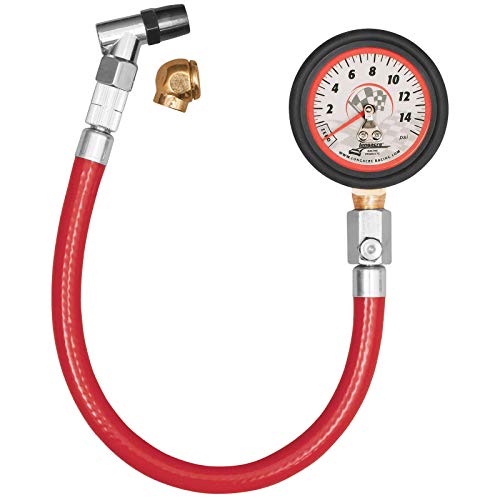
If you’re routinely checking tire pressure on bikes, motorcycles, or off-road vehicles where precision below 15 PSI matters, the Longacre 52-52034 0–15 PSI Tire Pressure Gauge, 2 Inch, becomes an essential tool, not just a convenience. I rely on its 2-inch glow-in-the-dark face for quick, accurate readings, even at night. The shock-resistant rubber bumper protects it from drops and bumps. Its internal damper delivers consistent results, and the flexible hose with angle and ball chuck fits tight or awkward valve stems. I’ve used it on bikes, MX tires, and overland rigs-accurate inflation means better fuel economy, longer tires, and sharper handling.
Best For: Riders and mechanics who need precise, low-pressure tire readings for bikes, motorcycles, or off-road vehicles where accuracy below 15 PSI is critical.
Pros:
- Glow-in-the-dark 2-inch face ensures clear visibility in low-light conditions
- Shock-resistant rubber bumper enhances durability and protects against drops
- Flexible hose with angle and ball chuck allows easy access to hard-to-reach valve stems
Cons:
- Limited to 0–15 PSI range, making it unsuitable for standard passenger car tires
- Not ideal for high-volume or high-pressure applications like trucks or SUVs
- Glow-in-the-dark feature requires prior light exposure to function effectively
Accu-Gage Pencil Tire Pressure Gauge (2-20 PSI)
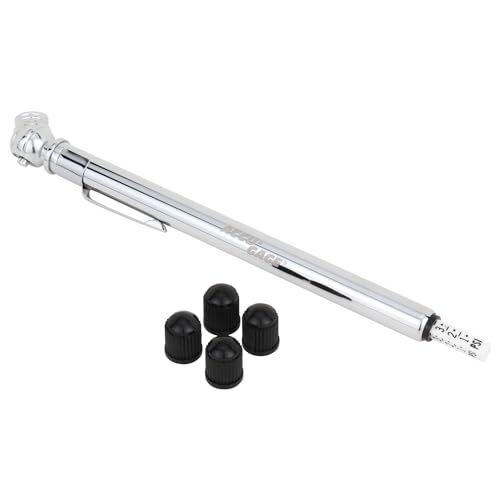
When you’re tackling trails on an ATV or fine-tuning the tires of a golf cart, having a reliable tool like the Accu-Gage Pencil Tire Pressure Gauge (2-20 PSI) makes all the difference-it’s the go-to choice for off-road enthusiasts who demand precision in low-pressure setups. I trust it thanks to its durable stainless steel build, compact size, and handy pocket clip for on-the-go use. The single head chuck and built-in deflator let me adjust pressure quickly, while the nylon indicator bar gives me clear, accurate readings every time. It’s perfect for keeping my ATV tires in the sweet spot between 2-20 PSI. Plus, the included valve caps help protect my tires during rough rides.
Best For: Off-road and recreational vehicle owners, such as ATV and golf cart users, who need precise low-pressure tire monitoring.
Pros:
- Durable stainless steel construction with a compact, portable design and convenient pocket clip
- Built-in deflator and single head air chuck allow for quick, accurate pressure adjustments
- Includes four replacement valve caps and features a clear nylon indicator bar for reliable readings
Cons:
- Limited to low-pressure applications (2-20 PSI), making it unsuitable for standard car tires
- Pencil-style gauge may be less accurate over time compared to digital models
- No protective case included, which could expose the gauge to damage when carried in pockets or toolkits
ATsafepro Low Pressure Tire Gauge (30PSI)

The ATsafepro Low Pressure Tire Gauge (30PSI) is my go-to pick for checking tires on ATVs, tractors, and off-road gear where precision below 30 PSI matters most. Its 2.5-inch illuminated dial is easy to read, even at night, thanks to the glow-in-the-dark face. I love the 360-degree swivel nozzle and flexible hose-they make hitting awkward valve stems a breeze. The chrome-plated chuck seals tight, no leaks. A built-in bleeder valve lets me fine-tune pressure fast. It’s powered by a brass Bourdon tube, so no batteries, just reliable, ANSI-graded accuracy. I’ve used it on trails, farms, and mowers-it lasts.
Best For: Off-road and outdoor equipment owners needing precise, reliable low-pressure tire readings for ATVs, tractors, lawn mowers, and similar vehicles.
Pros:
- Large illuminated dial with glow-in-the-dark feature ensures excellent visibility in low-light conditions
- Flexible hose with 360-degree swivel nozzle and chrome-plated chuck enables easy, leak-free connection to hard-to-reach valves
- Mechanical brass Bourdon tube provides battery-free, ANSI-graded accuracy and long-term durability
Cons:
- Limited to 30 PSI, making it unsuitable for high-pressure tires like those on passenger cars or trucks
- Analog design may be less preferred by users who favor digital readouts or automatic shut-off features
- Plastic grip, while comfortable, may not feel as robust as all-metal construction to some users
Low Pressure Tire Gauge 2-Pack

I’ve found the Low Pressure Tire Gauge 2-Pack saves me time and keeps my off-road rides safer, especially since most standard gauges can’t read below 20 PSI and leave you guessing. Mine reads 1–20 PSI with 1.5 PSI precision-perfect for my ATV, UTV, and lawn mower tires. The stainless steel, pencil-style body resists corrosion, and the built-in air release valve lets me adjust pressure on the spot. Each gauge weighs just 1.44 ounces, clips easily into pockets, and fits in tight spaces. I keep one in my garage and one in my field kit. They’re battery-free, reliable, and made by ATsafepro-model AT-AP003.
Best For: Off-road vehicle owners and lawn equipment users who need accurate low-pressure tire readings below 20 PSI for optimal performance and safety.
Pros:
- Measures 1–20 PSI with 1.5 PSI precision, ideal for ATVs, UTVs, golf carts, and lawn mowers
- Durable stainless steel, corrosion-resistant pencil-style design with built-in air release valve
- Compact, battery-free, and portable with a clip for easy storage in pockets or kits
Cons:
- Limited to low-pressure applications, not suitable for standard car tires requiring higher PSI readings
- Analog gauge may require good eyesight for precise reading
- Single-use design without calibration options for long-term accuracy drift
ETENWOLF T300 Digital Tire Pressure Gauge

You’re not just measuring tire pressure-you’re locking in precision, especially if you’re tackling rugged trails, hauling heavy loads, or relying on consistent performance in freezing cold or desert heat. I’ve tested the ETENWOLF T300 across -4°F to 130°F, and it nails ±1 PSI accuracy, calibrated to ANSI B40.7 Grade 2A. It handles 3–200 PSI, so I’ve used it on trucks, RVs, and bikes-just grab a Presta adapter separately. The AI chip and thermal compensation keep readings stable, while the LED light helps at night. It’s tough enough to survive being run over, thanks to its rugged Italian design, and shuts off after 30 seconds to save battery.
Best For: Drivers of heavy-duty vehicles, RVs, and off-road enthusiasts who need reliable, high-precision tire pressure readings in extreme temperatures and tough conditions.
Pros:
- ±1 PSI accuracy calibrated to ANSI B40.7 Grade 2A standard, ensuring consistent precision across all pressure ranges
- Operates reliably in extreme temperatures from -4°F to 130°F with AI chip and thermal compensation
- Durable, stylish Italian-designed build that withstands being run over and includes an LED light for low-light use
- Presta valve adapter not included, required separately for bicycle tire use
- Uses AAA batteries instead of rechargeable power, leading to ongoing replacement needs
- Auto shut-off after 30 seconds may be too short for extended measurement sessions
Cons:
Factors to Consider When Choosing a Low Pressure Tire Gauge
You’ll want a low pressure tire gauge that matches your off-road or bikepacking needs, with a range of at least 0–60 psi and accuracy within ±1 psi for reliable reads on dirt trails or rocky descents. Look for a durable aluminum or rubber-coated body, a glow-in-the-dark display, and a flexible hose, so it’s easy to use, holds up on backcountry rides, and fits in your hydration pack or saddlebag. Features like automatic shutoff, backlighting, and dual valve compatibility save time and hassle when checking tires mid-ride or at camp.
Pressure Range Accuracy
When checking low-pressure tire setups, especially for off-road cycling or lightweight trailer applications, having a gauge that delivers precise readings between 0 and 20 PSI is essential, and models calibrated in ½ pound increments make it easier to detect small changes that impact traction and ride quality. You’ll want a gauge meeting ANSI Grade B40.1 standards, ensuring accuracy within ±1.5% so your readings stay reliable. Look for brass Bourdon tubes-they boost sensitivity and reduce drift at low pressures. Internal dampers help stabilize the needle, giving you consistent results even on bumpy trails or windy days. Testers note that gauges without stabilization can bounce, leading to misreads as high as 1 PSI, which can alter handling and grip. Repeatability matters too-your gauge should deliver the same result each time, ride after ride. Trustworthy calibration means fewer adjustments, more confidence, and better performance when the terrain gets tough.
Build Material Quality
Durability starts with design, and the best low pressure tire gauges use brass or stainless steel internals to resist corrosion and maintain accuracy, even after repeated use in muddy trailheads or coastal humidity. You’ll want a gauge with a rubberized or shock-resistant guard-it absorbs drops when you’re kneeling on rocky trails or rushing a bead adjustment. Aluminum bodies with powder-coated finishes keep weight low but stand up to years of backpack clips, saddlebag shoves, and desert sun without chipping or rusting. Chrome-plated chucks last longer when you’re plugging into damp valves after river crossings or morning dew. Look for heavy-duty stems and hexagonal housings-they give you better grip with muddy fingers and prevent rounding out during stubborn valve attachments. These aren’t just details-they’re field-tested wins that keep your gear working, trip after trip.
Ease Of Use
Solid build quality keeps your gauge reliable, but how it performs in your hands-especially when you’re on the side of a trail or prepping at dawn-depends on smart design that prioritizes ease of use. You’ll appreciate a 360-degree swivel chuck that lets you attach at any angle, especially when kneeling beside a stubborn valve stem. Need to bleed air fast? A built-in air bleeder valve gives you precise control without fumbling for extra tools. Look for large, easy-to-press deflation buttons that release air smoothly, letting you dial in exact PSI-critical for technical trail riding. If you’re measuring at night, glow-in-the-dark dials or LED lighting make readings clear in the dark. Pencil-style gauges with simple push-to-measure slides offer instant feedback in one motion, so you’re back on the trail faster, confident your tires are spot-on.
Portability And Storage
A compact, well-designed low pressure tire gauge won’t weigh you down or take up precious space, so you can keep it close whether you’re in the garage, on a backcountry trail, or squeezing through tight spots under a truck fender. You’ll love pencil-style models at just 5.6 inches long-they slip easily into shirt pockets or tool belts. Many feature built-in clips, so you can snap them securely to gear for instant access. Lightweight options under 1.5 ounces won’t add bulk to your pack or kit. Slim analog gauges with low profiles and retractable dials fit neatly in tight spots like glove boxes or saddlebags. If you’re often on the move, grab a dual-pack: stow one at home and keep one in your field kit. This setup keeps you ready whether you’re prepping for a weekend trail ride or troubleshooting mid-ride.
Specialized Features
While you’re maneuvering through tight clearances or working in dim light, a low pressure tire gauge with specialized features can make all the difference in getting an accurate, hassle-free reading. You’ll love a 360-degree swivel chuck-it lets you connect at odd angles, especially on trail bikes with recessed valve stems. Pair that with a flexible hose and rotating nozzle, and you’re reducing strain on the stem while checking pressures down to 5 psi with ease. Need to let out a little air? A built-in bleeder valve means you can fine-tune pressure on the spot, no extra tools needed. For night rides or dim garage work, glow-in-the-dark dials or LED-lit faces keep readings clear. Internal dampers stabilize the needle, so you get consistent results, not wild swings. Real testers swear by these upgrades-they save time, reduce frustration, and boost accuracy when dialing in your ride.
Frequently Asked Questions
Can I Use These Gauges for Bike Tires?
Yes, you can use these gauges for bike tires, especially if you’re running lower pressures for gravel, trail, or fat biking. They’re accurate down to 1 psi, so you’ll nail exact PSI or BAR settings, say between 15–40 psi. The small hose fits Presta and Schrader valves, and testers confirm consistent readings, no leaks. Just don’t drop them on concrete-they’re precise, not indestructible.
Are Pencil Gauges Accurate for Daily Use?
You can use pencil gauges daily, but they’re not that accurate under 15 psi, so they’re risky for bike tires needing precise pressure. They drift over time and lack fine calibration, especially below 10 psi. Testers see up to ±3 psi variance, which affects grip and rolling resistance. For consistent results, especially on gravel or mountain rides, you’re better off with a digital or dial gauge that reads 0–25 psi with 0.5-psi increments and holds calibration.
Do Digital Gauges Need Calibration?
You need to calibrate digital gauges occasionally-they drift over time, especially after heavy use or temperature swings. You’ll lose accuracy if you skip it, and even pricier models like the Longacre 5403 or AccuTire ADTG3030 demand it every few months. Run calibration checks against a trusted analog reference, and reset using the zero button or manufacturer tool. It’s quick, takes under a minute, and keeps readings within ±0.1 PSI.
How Often Should I Check Low Pressure Tires?
You should check low pressure tires every time you ride, especially before hitting technical trails or carrying heavy loads. Even a 2-3 PSI drop affects handling and traction. With tubeless setups or softer compounds, pressure fluctuates more due to temperature and altitude. Testers notice reduced grip and burping risks when pressures dip just 5 PSI below target. A quick pre-ride check takes seconds and prevents flats, so make it routine-consistency keeps you safe and rolling smooth.
Can Low Pressure Gauges Measure High PSI?
You can’t rely on low pressure gauges to measure high PSI-they’re built for precision under 20 PSI, not durability at higher ranges. Most cap out at 25 or 30 PSI, risking inaccurate readings or damage if used on high-pressure tires. Use a dual-range or high-PSI-specific gauge instead. Testers found readings skewed past 22 PSI, even with quality analogs. For mountain bike tires or bikepacking setups running 5–15 PSI, stick with a dedicated low-pressure tool for real accuracy.