Best Beam Torque Wrenches for Precision and Durability
You get reliable precision and lasting durability with beam torque wrenches built from high-strength alloy steel, like the Neiko 1/4-inch model, accurate to ±4% from 0–80 in/lbs in 1 in/lb increments, or the rugged Tooluxe Dual Drive handling up to 150 ft-lbs with a mirrored scale to reduce parallax error. Choose the TEKTON 1/2-inch drive for heavy-duty tasks at 40–250 ft-lbs, certified to ASME standards, or the compact Venzo 1/4-inch set with fine 0.25 Nm increments, ideal for carbon fiber parts. Each maintains calibration without springs, resists wear, and delivers consistent accuracy-even after repeated use. Find which model best fits your tool needs based on drive size, torque range, and real-world performance.
We are supported by our audience. When you purchase through links on our site, we may earn an affiliate commission, at no extra cost for you. Learn more. Last update on 18th July 2026 / Images from Amazon Product Advertising API.
Notable Insights
- Beam torque wrenches offer ±4% accuracy and stable calibration due to spring-free, solid steel beam design.
- High-strength alloy steel construction resists bending and ensures long-term durability under repeated use.
- 1/4-inch drive models are ideal for precision tasks with 0–80 in-lb range and fine 1 in-lb increments.
- Dual-scale, mirrored, and parallax-reducing markings enhance readability and measurement precision.
- Corrosion-resistant finishes and secure drive ends improve longevity and socket compatibility across environments.
Neiko 1/4-Inch Beam Torque Wrench

If you’re a cyclist or mechanic who demands precision on small, sensitive fasteners-especially when building or tuning a bike-this Neiko 1/4-inch beam torque wrench is your go-to tool. I rely on its dual SAE and metric scales, reading 0–80 in/lbs in 1 in/lb steps and 0–9 Nm in 0.25 Nm increments, so I never need conversion charts. It’s calibrated to ±4%, giving me confidence on carbon bolts and derailleur fittings. The bidirectional design works smoothly for left- or right-handed use, and the long beam reaches tight spots. Ball detent and chamfered ends hold sockets securely, while the grip stays comfortable during repeated use.
Best For: Cyclists, mechanics, and DIY enthusiasts who need precise torque control for small, sensitive fasteners in tight spaces.
Pros:
- Dual SAE and metric scales eliminate the need for conversion charts and allow precise readings from 0–80 in/lbs and 0–9 Nm
- Calibrated to ±4% accuracy for reliable torque application on delicate components like carbon fiber and derailleur systems
- Bidirectional, ergonomic design with a long beam and secure ball detent for easy access and comfortable use in tight or awkward spaces
Cons:
- Beam-style design requires line-of-sight for accurate reading, which can be difficult in confined areas
- Lower torque range limits use to small fasteners, making it unsuitable for heavy-duty automotive applications
- Lack of a adjustable click mechanism may reduce convenience compared to preset torque wrenches
Tooluxe Dual Drive Torque Wrench (0-150 Ft-Lbs)

I trust the Tooluxe Dual Drive Torque Wrench when I need precise, repeatable torque settings without the hassle of recalibration, especially since its beam deflection design delivers consistent accuracy from 0 to 150 ft-lbs. I love the dual 3/8-inch and 1/2-inch drive anvils-they let me switch tasks fast, from small engine bolts to suspension work. The mirrored scale reduces parallax, and the dual-direction markings make reading in both ft-lbs and m-kg effortless. Its 17-inch high-strength steel shaft gives serious leverage, while the grooved handle keeps my grip secure. The chrome finish resists rust, and I’ve used it for months without any drift in accuracy.
Best For: Automotive mechanics and DIY enthusiasts who need a durable, accurate, and versatile torque wrench for precise fastening in both imperial and metric units.
Pros:
- Beam deflection design ensures consistent accuracy without requiring recalibration
- Dual 3/8-inch and 1/2-inch drive anvils enhance versatility across a wide range of automotive tasks
- High-strength steel construction with corrosion-resistant chrome finish ensures long-term durability
Cons:
- Beam-style design is bulkier and less ergonomic than click-type wrenches
- Requires clear line of sight for reading the scale, which can be difficult in tight spaces
- Lacks audible or tactile feedback when reaching torque setting, increasing risk of over-torqueing if not careful
1/4″ Drive Beam Torque Wrench (0-80 in-lb)

You’ll find the MILMUMU 1/4″ Drive Beam Torque Wrench (0–80 in-lb) especially useful if you work on small, precision fasteners where accuracy matters, like those on bikes, garden tractors, or automotive systems, because its beam-style design eliminates parallax error with a clear, graduated indicator tip. I trust this rugged, 11-inch tool made from alloy steel, not just for its mirror-chrome, corrosion-resistant finish, but because it delivers repeatable accuracy across 0–9 Nm. The textured black handle gives me solid grip, and the fixed 1/4″ drive guarantees stability on SAE or metric fasteners. Weighing just 0.32 ounces, it’s lightweight but durable, and backed by a 1-year warranty-perfect for delicate jobs where over-torquing could ruin sensitive components.
Best For: DIY enthusiasts, cyclists, and automotive technicians who need a lightweight, accurate torque wrench for small, precision-fastening tasks.
Pros:
- Beam-style design with graduated indicator eliminates parallax error for precise readings
- Durable alloy steel construction with corrosion-resistant mirror-chrome finish
- Textured handle and fixed 1/4″ drive ensure secure grip and stability on SAE and metric fasteners
Cons:
- Limited torque range (0–80 in-lb) makes it unsuitable for heavy-duty applications
- Beam-style wrench requires line-of-sight reading, which can be less convenient than click-style models
- Very low weight (0.32 oz) may feel insubstantial or less durable to some users
1/4-Inch Drive Beam Torque Wrench

The 1/4-inch drive beam torque wrench is my go-to tool when precision matters most on small to medium fasteners, especially in tight spaces where over-torquing risks damage. I rely on its 0–80 in/lb and 0–9 Nm range, with clear 2.5 in/lb and 0.25 Nm increments, giving me ±4% accuracy-no guesswork. The dual-scale beam means I skip conversion charts, switching seamlessly between SAE and metric. Its rugged steel body has a mirror-chrome finish that resists corrosion, and the deflection beam never loses calibration. I appreciate the high-visibility markings and textured handle for steady use, whether I’m tuning my bike, working on a car, or maintaining my boat.
Best For: Precision torque applications in automotive, bicycle, and marine maintenance where small to medium fasteners require accurate, repeatable tightening.
Pros:
- ±4% accuracy with dual-scale SAE and metric readings eliminates need for conversions
- Durable steel construction with corrosion-resistant mirror-chrome finish ensures longevity
- Deflection beam design maintains calibration without wear or fatigue over time
Cons:
- Limited torque range (up to 80 in/lb or 9 Nm) makes it unsuitable for high-torque applications
- Beam design requires line-of-sight to read, which can be awkward in tight spaces
- No built-in torque release mechanism, increasing risk of over-torquing if not carefully monitored
TEKTON 1/2″ Drive 72-Tooth Torque Wrench
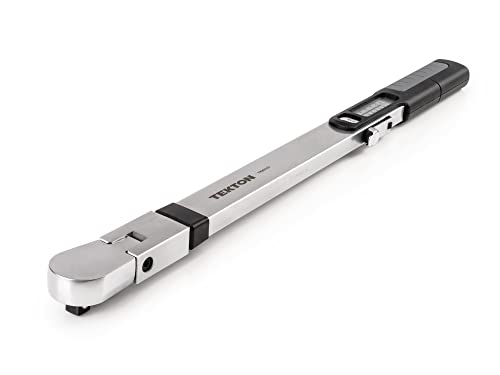
A dependable choice for mechanics and DIYers tackling everything from suspension work to drivetrain overhauls, the TEKTON 1/2″ Drive 72-Tooth Torque Wrench delivers precision across a 40–250 ft.-lb. range, with ±4% accuracy certified to ASME B107.300-2010 standards. I trust this wrench because it’s individually serialized and comes with a certificate documenting calibration. The smooth-turning thumbscrew makes adjustments easy, while the flip-up cover locks the setting securely. Its scale lets me quickly convert between ft.-lb. and N⋅m, and I appreciate not having to reset it before storage-accuracy stays intact. It includes a case and manual, so I keep everything organized and handy.
Best For: Mechanics and DIYers who need a reliable, accurate torque wrench for demanding automotive tasks like suspension or drivetrain work.
Pros:
- High accuracy of ±4% across a broad 40–250 ft.-lb. range, certified to ASME B107.300-2010 standards
- Flip-up cover locks torque setting securely in place during use, preventing accidental adjustments
- No need to reset to lowest setting for storage, preserving calibration and extending tool life
Cons:
- Lacks a digital display, which may be preferred by users seeking precise real-time feedback
- Limited to 1/2″ drive applications, making it unsuitable for smaller fasteners requiring lower torque
- Heavier and bulkier than smaller torque wrenches, potentially less convenient for tight spaces
ARES 3/8-Inch Drive Torque Wrench (0-800 in/lb)

When precision matters on the trail or in the garage, the ARES 70214 3/8-inch Drive Beam Torque Wrench delivers consistent, reliable performance for cyclists, motorcyclists, and DIY mechanics who demand accuracy without guesswork. I trust its 0–800 in/lb range, with clear 25 in/lb increments, and it’s accurate to ±4%. The dual-scale beam shows both inch-pounds and newton-meters, so I skip conversions. Its alloy steel build feels durable, and the 11.11-inch length fits tight spaces. I’ve used it clockwise and counter-clockwise on bike cranks and moto parts with no slip. No internal springs mean it won’t lose calibration. ARES backs it with solid support, and I appreciate their ASPCA partnership. It’s simple, honest tooling that just works.
Best For: Cyclists, motorcyclists, and DIY mechanics who need a reliable, no-frills torque wrench for precise fastening in tight spaces.
Pros:
- Durable alloy steel construction with high-visibility dual-scale markings for easy reading in inch-pounds and newton-meters
- Beam design ensures long-term accuracy without calibration drift or internal spring wear
- Capable of both clockwise and counter-clockwise torque application with a compact 11.11-inch length
Cons:
- Limited to 800 in/lb (90 Nm) maximum torque, making it unsuitable for high-torque automotive applications
- Beam-style reading requires line-of-sight alignment, which can be less convenient than a click-style wrench
- No included storage case or protective cover to safeguard the wrench from scratches or impacts
GEARWRENCH 3/8″ Drive Beam Torque Wrench 0-800 in/lbs. – 2956N , Black

Built for mechanics who demand accuracy without relying on batteries or complex mechanisms, this beam-style torque wrench delivers consistent, real-world precision thanks to its simple, dependable design. I use my GEARWRENCH 2956N daily, and it holds calibration without fuss, measuring 0–800 in/lbs with a clear, easy-to-read beam. At 16 inches long, it fits tight spaces, the 3/8-inch drive ratchets smoothly, and the polished alloy steel feels durable, not brittle. It’s non-sparking, made in Taiwan, and the black finish resists corrosion. I appreciate the hang hole for storage, and it comes with an adjustable wrench. GEARWRENCH backs it with a 1-year warranty, 90-day calibration guarantee-I trust it, and so should you.
Best For: Mechanics and DIY enthusiasts who need a reliable, battery-free torque wrench for precise fastening in automotive, machinery, or equipment maintenance.
Pros:
- Durable alloy steel construction with a non-sparking, corrosion-resistant black polished finish
- Beam-style design ensures consistent accuracy without requiring recalibration often
- Includes adjustable wrench and hang hole for added utility and convenient storage
Cons:
- Beam design requires line-of-sight to read torque, which may be less convenient in tight angles
- No reverse ratcheting function, limiting efficiency in confined spaces
- Calibration warranty only covers 90 days, shorter than some competitors
Presa 3/8 in. Drive 10-80 ft-lbs Beam Torque Wrench

If you’re tackling routine maintenance on cars, trucks, or garden tractors and need a no-nonsense torque wrench that delivers accuracy without relying on batteries or complex mechanisms, the Presa 3/8 in. drive beam wrench is my go-to. It spans 10–80 ft-lbs with a dual-scale, SAE-inched beam and a graduated tip that kills parallax error. I like its rugged alloy steel build, mirror-chrome finish, and textured black handle-it feels solid, resists corrosion, and grips well. It’s lightweight at 1.55 pounds, reliable, and calibrated for both directions. Backed by a 1-year warranty and scoring 4.6 stars from real users, it’s proven repeatable, precise, and ideal for everyday mechanical work.
Best For: DIY mechanics and automotive enthusiasts who need a reliable, battery-free torque wrench for precise, everyday tightening tasks on cars, trucks, and garden tractors.
Pros:
- Durable alloy steel construction with corrosion-resistant mirror-chrome finish for long-lasting performance
- Dual-scale beam with graduated tip eliminates parallax error, ensuring accurate readings in both directions
- Lightweight at 1.55 pounds with a textured handle for secure grip and easy control
Cons:
- Limited torque range (10–80 ft-lbs) makes it unsuitable for heavy-duty or high-torque applications
- Beam-style design requires visual alignment, which can be less convenient than a click-style wrench
- Lower customer review count (76 reviews) may limit comprehensive feedback for some buyers
OEMTOOLS 1/4-Inch Beam Torque Wrench

I reach for the OEMTOOLS 1/4-Inch Beam Torque Wrench whenever I’m fine-tuning small fasteners on my bike or motorcycle, where precision matters most. It delivers 0–80 in-lbs (0–9 Nm) of torque with a stiff, hardened steel beam that resists bending, so readings stay accurate over time. The dual scale shows both inch pounds and Newton meters, making it easy to switch between units on the fly. I appreciate that it works clockwise and counterclockwise, which comes in handy on tight engine builds. Built tough with durable steel, it fits 1/4-inch drives and handles jobs on cars, boats, and bicycles without fuss.
Best For: DIY mechanics and professionals who need precise, reliable torque measurements for small fasteners on vehicles like motorcycles, bikes, cars, and boats.
Pros:
- Delivers accurate 0–80 in-lbs (0–9 Nm) torque with a hardened steel beam for long-term reliability
- Features a dual scale (inch pounds and Newton meters) for flexible, easy-to-read measurements
- Bidirectional usability allows for consistent performance in both clockwise and counterclockwise applications
Cons:
- Limited torque range makes it unsuitable for high-torque automotive applications
- Beam-style design requires line-of-sight for reading, which can be awkward in tight spaces
- No audible click or alert when reaching set torque, requiring constant visual monitoring
Venzo 1/4″ Beam Torque Wrench Set

You’ll want the Venzo 1/4″ Beam Torque Wrench Set if you’re tightening critical bolts on carbon fiber frames or small-diameter fasteners common in modern MTB, road, and motorcycle builds, where over-torquing risks damage and under-torquing compromises safety. I rely on its 2–10 Nm range for precise, repeatable results, and the beam-style design stays accurate without recalibration. It’s compact enough to stash in my saddle bag, and the included hex bits-2, 2.5, 3, 4, 5, 6, 8 mm-plus PH2, T10, and T25 cover nearly every bolt I encounter. Built tough and backed by a 2-year warranty, it’s a trusty, no-fuss tool I bring on every ride.
Best For: Cyclists and motorcyclists who need precise, portable torque control for maintaining carbon components and small fasteners across MTB, road, and motorcycle builds.
Pros:
- Offers accurate, calibration-free beam-style design with a 2–10 Nm range for sensitive components
- Compact and lightweight, fitting easily in saddle bags for on-the-go maintenance
- Comes with a comprehensive set of included bits (hex, PH2, T10, T25) covering most common fasteners
Cons:
- Limited torque range makes it unsuitable for high-torque applications
- Beam-style design may be less convenient than click-style wrenches for quick adjustments
- No carrying case included, risking bit loss or tool damage during transport
Factors to Consider When Choosing a Beam Torque Wrench
You’ll want to match the torque range to your fasteners, like 20–200 ft-lb for most bike crank bolts or 10–80 Nm for motorcycle fittings, so check your needs before buying. Pick the right drive size-1/4-inch for small screws, 3/8-inch for general use, or 1/2-inch for heavy lug nuts-and make sure the beam wrench has a dual scale in both ft-lb and Nm for easy reading. Look for a rugged steel beam, a zero-reset adjustment knob, and a clear graduation scale with sharp, non-glare markings that stay accurate over time.
Torque Range Compatibility
When tackling fastening tasks with precision, matching your beam torque wrench to the correct torque range is essential for both accuracy and tool longevity. You’ll find beam wrenches ranging from 0–80 in/lb for delicate electronics or small fasteners up to 10–150 ft-lb for automotive or industrial jobs, so pick one that covers your typical work. Look for models with fine increments-like 1 in/lb or 0.25 Nm-for sensitive adjustments on critical components. Dual-scale wrenches give you both SAE and metric readings side by side, so you’re never guessing when switching between systems. Always guarantee the wrench’s max capacity exceeds your highest torque needs to avoid inaccurate readings or bending the beam. Bidirectional scales let you apply torque clockwise or counterclockwise without losing precision, making them versatile for complex assemblies.
Drive Size Selection
While matching torque range to the task keeps your measurements accurate, selecting the right drive size guarantees the tool fits both your fasteners and workload. You’ll usually choose from 1/4-inch, 3/8-inch, or 1/2-inch drives. Go with 1/4-inch for low-torque jobs-think 0–80 in-lbs-perfect for delicate, precision work. The 3/8-inch drive is your go-to for versatility, handling 0–800 in-lbs or 10–80 ft-lbs, ideal for general repairs. When tackling heavy-duty tasks, like lug nuts or suspension parts, use a 1/2-inch drive; it delivers 40 to 250 ft-lbs, ensuring reliable power. Make sure your wrench’s drive matches your socket set-mismatches risk inaccuracy and wear. Testers report smoother operation and longer tool life when drive size aligns with both fastener size and torque demands.
Accuracy And Calibration
Since precision matters every time you tighten a fastener, beam torque wrenches deliver consistent accuracy with a typical tolerance of ±4%, so you can trust each measurement falls within a reliable range. You benefit from their stable calibration, thanks to a simple design with no springs or moving parts to wear out over time. The solid deflection beam resists fatigue, so your readings stay accurate even after repeated use in tough conditions. You’ll also avoid parallax error, because the graduated indicator tip aligns clearly with the scale when viewed head-on. Even in high-precision models, you get dependable performance without needing conversion charts. These wrenches hold their calibration longer than click-type wrenches, meaning less downtime and fewer trips to the calibration lab. When you need repeatable, trustworthy torque readings in the field or garage, a beam wrench gives you confidence with every turn.
Dual Scale Readability
How easy is it to switch between measurement systems without fumbling through conversions? With a beam torque wrench featuring dual scale readability, you get instant access to both SAE (inch-pounds) and metric (Newton meters) side by side. You’ll read values directly, no math needed. Parallel markings let you align the pointer quickly, whether you’re working clockwise or counterclockwise. Look for fine increments like 1 in/lb and 0.25 Nm for precision on delicate jobs. High-visibility scales with graduated indicator tips reduce parallax error, so your readings stay consistent. Dual-direction labeling means you won’t lose accuracy when reversing torque direction. You’ll save time and avoid mistakes, especially when switching between U.S. and metric fasteners on bikes, trailers, or outdoor gear. Clear, well-spaced numbering keeps your workflow smooth, even in tight spaces or low light.
Durability Of Construction
You’ve seen how dual scale readability saves time and reduces errors when switching between inch-pounds and Newton meters, especially on mixed-fastener bikes or trailer hitches, and now let’s look at what keeps the tool reliable over years of trail use and garage work. You need a beam made from high-strength alloy steel-it resists bending and fatigue, so accuracy stays true without constant recalibration. A mirror-chrome finish fights rust, even in damp garages or rainy trail conditions. Hardened steel beams handle repeated 80 lb-ft cycles without deformation. Look for chamfered or ball detent drive ends-they lock sockets in place and reduce wear. Powder-coated or polished finishes add extra defense against abrasion, brake fluid, and road grime. These aren’t just features-they’re field-tested upgrades that mechanics and cyclists trust when torque consistency matters most.
Ergonomic Handle Design
When you’re applying precise torque in greasy engine bays or crouched under a bike frame, a well-designed handle makes all the difference, and beam torque wrenches with ergonomic grips deliver right where it counts. You’ll want a textured or grooved surface-it keeps your grip secure, even with oily hands. Contoured, cushioned handles reduce hand fatigue during repeated use, while non-slip materials boost control in tight spaces. Look for a handle length between 10 and 14 inches, with a 1.25-inch diameter for ideal leverage and comfort, whether you’re left- or right-handed. High-visibility coloring or contrasting zones help you position your hands quickly and accurately. Testers consistently note that these features cut strain during long jobs and improve precision on delicate fasteners. A smart handle isn’t just comfy-it’s a direct upgrade to accuracy and safety in real-world conditions.
Bidirectional Functionality
Though many torque tools limit you to a single direction, a bidirectional beam torque wrench gives you full flexibility to tighten or loosen fasteners clockwise and counterclockwise without flipping or resetting the tool. You get accurate readings in both directions, thanks to the passive beam’s consistent deflection. This design maintains calibration, so you won’t lose precision over time. Whether you’re working in tight engine bays or adjusting components that need back-and-forth torque, the bidirectional function saves time and effort. Unlike click-style wrenches that often require disengagement or direction changes, your beam wrench delivers seamless performance. You can rely on it for repetitive tasks, where switching directions is routine. There’s no internal mechanism to wear out, just reliable, real-time feedback. With a typical range of 20–250 ft-lbs and clear scale visibility, it’s a smart, durable choice for precision work you can trust again and again.
Application Specific Use
A beam torque wrench tailored to your specific task guarantees precision and durability where it matters most. If you’re working on bikes or motorcycles, grab a model with a 0–80 in/lbs range-it’s perfect for snugly tightening bolts on carbon frames without cracking them. You’ll love dual-scale calibrations in both inch-pounds and Newton meters; they make switching between U.S. and metric fasteners a breeze, especially on boats or imported vehicles. Need to loosen and retighten repeatedly? Go for bidirectional models-they’ve got you covered. High-visibility markings and sharp indicator tips cut parallax issues, so you read right the first time, even in dim corners. And thanks to rugged alloy steel builds with rust-fighting finishes, these wrenches won’t quit on you during gritty outdoor repairs or salty marine work. Pick the right one, and every turn counts.
Frequently Asked Questions
How Do I Calibrate a Beam Torque Wrench at Home?
You can’t truly calibrate a beam torque wrench at home-you need a certified lab for accurate recalibration. But you can check its accuracy using a known weight and a breaker bar setup. Hang a precise 20-pound weight on the wrench’s drive at a measured distance, like 12 inches, then verify the pointer reads 20 ft-lbs. If it’s off, note the error for reference, but don’t adjust it yourself.
Can Beam Torque Wrenches Be Used on Electrical Components?
You can use beam torque wrenches on electrical components, but you’ve got to be precise, gentle, and within spec-most connectors need just 5 to 8 in-lbs. Their analog needle gives real-time feedback, so you won’t over-tighten delicate terminals. Unlike click wrenches, beams don’t lose calibration from backing off, making them reliable for sensitive work. Always check manufacturer specs, match the drive size, and apply force steadily, slowly, with two hands for maximum control.
Do Beam Torque Wrenches Lose Accuracy Over Time?
You’ll find beam torque wrenches keep their accuracy longer than most tools because they’ve got no internal springs to weaken, and testers confirm they stay within ±4% over years of field use. You won’t need frequent recalibration like click-type wrenches, especially if you store them properly. Real-world trials show consistent 25–150 ft-lb performance across rugged job sites, making them reliable, low-maintenance choices when precision matters.
Are Beam Torque Wrenches Suitable for Aerospace Applications?
Yes, you can use beam torque wrenches in aerospace applications because they’re inherently accurate, don’t drift with use, and require no recalibration, making them reliable for critical fastening, 25–250 in-lb models handle small fittings, while 50–1000 ft-lb versions manage larger assemblies, testers confirm consistent readings even after repeated cycles, their simple design resists wear, they’re often found in FAA-approved toolkits, and you won’t worry about internal springs or mechanisms failing under precision demands.
What’s the Difference Between Beam and Click Torque Wrenches?
You’ll find beam torque wrenches show readings on a scale with a moving pointer, giving you constant feedback, while click types make a sound when reaching set torque. Beam models stay accurate longer, need no resetting, and resist wear, but click wrenches are faster, easier in tight spots. You’ll feel the beam’s physical response, which pros like for consistency, especially on critical aerospace bolts.